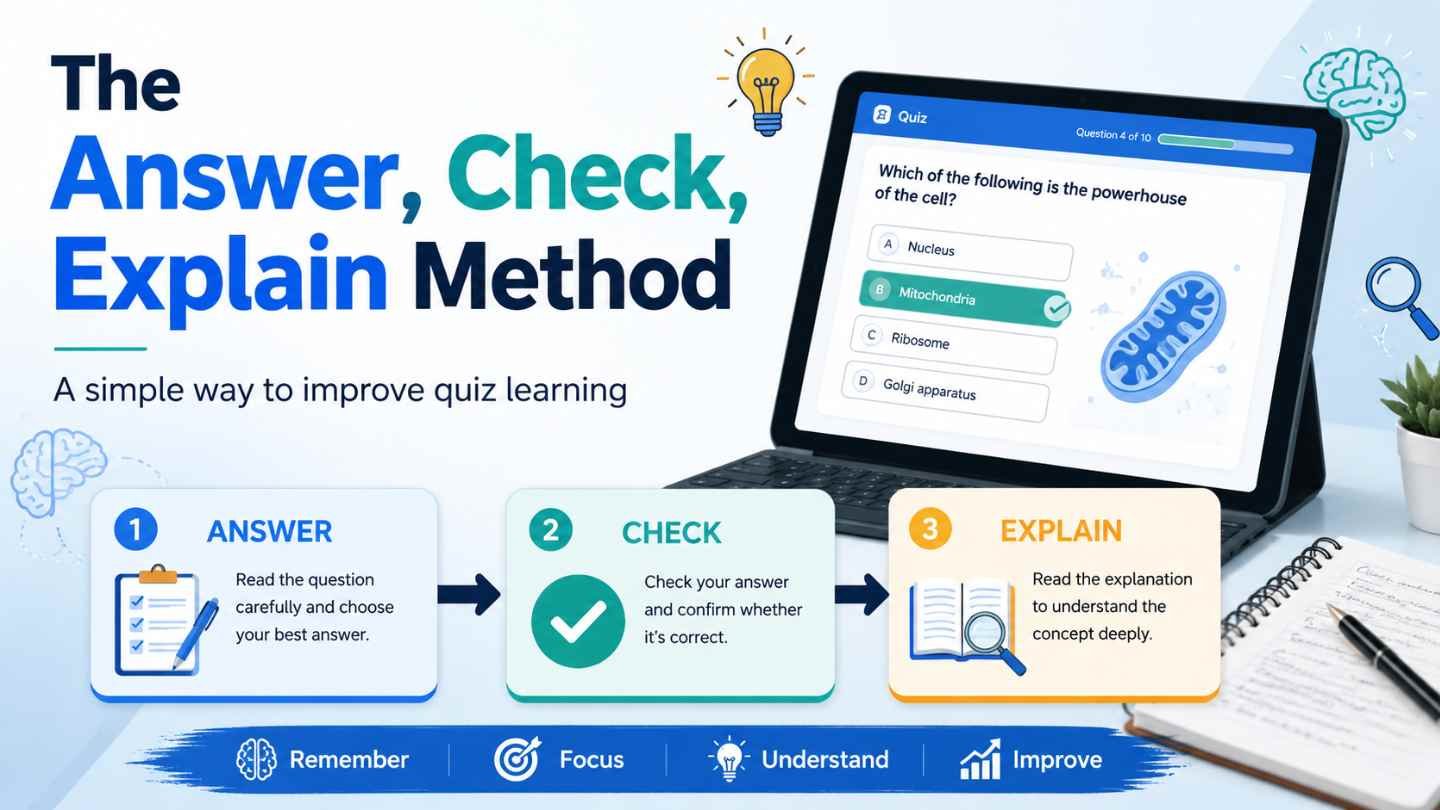
Quizzes are not only for testing what you already know. They can also help you notice what you almost know, what you guessed correctly, and what you need to understand better. That is where the Answer, Check, Explain Method becomes useful.
This simple three-step method can make quiz learning more active and meaningful. Instead of clicking an answer, seeing if you were right, and moving on, you pause long enough to learn from the question. You answer first, check the result, then explain why the answer is correct or wrong.
That small extra step can make a big difference. It turns a quiz from a quick guessing game into a useful memory exercise. Whether you enjoy educational quizzes, daily quizzes, or general knowledge questions, this method helps you learn from every result.
What Is the Answer, Check, Explain Method?
The answer check explain method is a simple way to use quizzes for better learning. It has three steps: answer the question first, check whether your answer is right or wrong, then explain the reason behind the result.
The important part is that you do not skip straight to the answer. You make your brain try first. That effort matters because recall practice strengthens memory more than simply reading the correct answer. Even if you get the question wrong, your brain has already started working with the information.
After checking the result, the explanation step helps you understand the “why.” This is where real quiz learning begins. You are not just collecting correct answers. You are building clearer knowledge.
Step 1: Answer First
The first step is simple: answer before you check. Do not peek. Do not rush to the explanation. Give your brain a chance to search for the answer.
This step matters because memory improves when you try to recall information. When you answer first, you are practicing retrieval. That means you are pulling knowledge from your memory instead of only recognizing it when you see it.
For example, if a quiz asks, “Which planet is known as the Red Planet?” you may quickly answer “Mars.” That is not just a fact you saw. It is a fact you retrieved. The act of recalling it helps make the memory stronger.
Step 2: Check the Result
After answering, check whether you were correct. This gives you feedback. Feedback is useful because it tells you whether your memory is accurate, incomplete, or confused.
But checking the answer is not enough. Many people stop here. They see the correct answer, feel satisfied or disappointed, then move to the next question. That may feel like learning, but it often becomes shallow.
A checked answer tells you the result. It does not always tell you the reason. That is why the next step is the most important part of the method.
Step 3: Explain Why
The third step is to explain why the answer is correct or why your answer was wrong. You can do this out loud, in your head, or in one short sentence.
For example, if the question asks, “What gas do plants absorb during photosynthesis?” and the answer is carbon dioxide, do not just memorize the phrase. Explain it: “Plants use carbon dioxide, water, and sunlight to make food, and oxygen is released as a byproduct.”
That explanation gives the fact a place to live in your mind. You are connecting the answer to a reason, a process, or a bigger idea. This is what makes quiz learning more useful than simple answer checking.
Why This Method Works for Quiz Learning
The Answer, Check, Explain Method works because it combines recall, feedback, and understanding. Answering first trains memory. Checking gives correction. Explaining builds meaning.
Many learners get stuck because they confuse familiarity with knowledge. A fact may look familiar when they see it, but they may not be able to explain it. This method helps close that gap.
It also improves focus. Instead of racing through questions, you slow down just enough to notice what is happening in your mind. You begin to see which facts you truly know, which ones you guessed, and which ones need review.
How to Use the Method With Correct Answers
When you get an answer correct, do not skip the explanation. A correct answer can still be weak knowledge if you cannot explain it clearly.
Ask yourself: “Why is this answer right?” If you can explain it in simple words, you probably understand it. If you cannot explain it, you may have answered from memory without full understanding.
For example, if you correctly answer that the Nile is often cited as one of the world’s longest rivers, explain where it is and why it is commonly discussed in geography quizzes. The explanation helps turn a correct answer into stronger general knowledge.
How to Use the Method With Wrong Answers
Wrong answers are not failures. In quiz learning, they are useful signals. They show where your memory needs repair.
When you miss a question, do not only look at the correct answer. Ask yourself why your answer seemed believable. Did you confuse two people, two dates, two places, or two similar terms?
For example, if you choose Thomas Edison when the answer is Nikola Tesla, the mistake may show that you are mixing up inventors linked to electricity. That is helpful. Now you know what to review instead of simply saying, “I got it wrong.”
How to Use the Method With Guessed Answers
Guessed answers deserve special attention. Sometimes you guess correctly, but that does not mean you truly know the fact.
When you guess, mark the question mentally as “not fully known.” Then explain why the correct answer makes sense. This prevents lucky guesses from tricking you into thinking your knowledge is stronger than it really is.
For daily quizzes, this is especially helpful. You may get a high score because of good guessing, but the explain step shows whether you actually understood the questions.
How to Use the Method With Tricky Questions
Tricky questions are useful because they train careful reading. They often include answer choices that look similar or contain small details that change the meaning.
When a question feels tricky, slow down and explain why the wrong choices are wrong. This helps you avoid memorizing only the correct option. It also teaches you to notice details.
For example, a history quiz might ask about a battle, a treaty, or a leader from the same time period. The wrong choices may be close, but not exact. Explaining the difference makes your memory sharper.
A Simple Example of the Method
Question: What is the capital city of Australia?
Answer first: You choose Sydney.
Check: The correct answer is Canberra.
Explain: Sydney is a major Australian city, but Canberra is the capital. It was selected as a planned capital between Sydney and Melbourne.
That short explanation changes the mistake into a useful memory. Next time, you are less likely to choose Sydney just because it is more famous.
Practical Tips for Daily Quiz Learning
Use the method with a small number of questions at first. You do not need to write a long explanation for every answer. One clear sentence is enough.
For correct answers, explain the reason. For wrong answers, explain the correction. For guessed answers, explain why the right answer fits. For tricky questions, explain why the tempting wrong option does not work.
This makes daily quizzes more valuable. You are not only chasing a score. You are building memory, curiosity, and better recall one question at a time.
Why Checking Alone Is Not Enough
Checking an answer gives you feedback, but feedback without explanation can disappear quickly. You may recognize the correct answer today and forget it tomorrow.
Real learning happens when you connect the answer to a reason. That reason may be a definition, a cause, a timeline, a comparison, or a simple example. The more meaning you attach to the answer, the easier it becomes to remember.
This is why educational quizzes work best when they include answer review. A good quiz does not only tell you what you got right. It helps you understand why.
How This Method Builds Curiosity
One underrated benefit of the Answer, Check, Explain Method is curiosity. When you explain an answer, you often discover a follow-up question.
A science question may make you wonder how something works. A history question may make you curious about what happened next. A geography question may make you want to find the place on a map.
That curiosity keeps learning alive. A quiz becomes more than a score. It becomes a doorway into a bigger topic.
Using the Method With General Knowledge Quizzes
General knowledge quizzes are perfect for this method because they cover many topics. You may answer questions about science, history, geography, language, sports, entertainment, and current events in one session.
Without explanation, those facts can feel random. With explanation, they become connected. You start to understand not only the answer but also the category behind it.
For example, a question about the Great Wall of China can lead to history, geography, architecture, and culture. One quiz question can open a wider learning path when you take a moment to explain it.
You can also try practice quizzes at quiz bing and use the Answer, Check, Explain Method as you go through each question.
A Quick Routine You Can Use
Here is a simple routine for better quiz learning:
- Answer the question without checking.
- Check the correct answer.
- Explain the answer in one sentence.
- Mark guessed or confusing questions for review.
- Revisit difficult questions later.
This routine does not need to take long. Even five quiz questions can become a useful learning session when you answer, check, and explain carefully.
Common Mistakes to Avoid
One common mistake is rushing through the quiz just to finish. Speed can be fun, but if your goal is memory improvement, you need a little reflection.
Another mistake is ignoring guessed answers. A correct guess feels good, but it can hide a weak spot. Treat guessed answers as review items, even when your score looks strong.
A third mistake is memorizing only the letter of the answer. If you remember “B” but not the reason, you have not learned much. The goal is to understand the idea behind the answer.
FAQ: The Answer, Check, Explain Method
1. What is the Answer, Check, Explain Method?
The Answer, Check, Explain Method is a three-step quiz learning strategy. You answer the question first, check the result, then explain why the answer is correct or wrong. It helps turn quiz results into real learning.
2. Why is this method useful for quiz learning?
It is useful because it combines recall practice, feedback, and explanation. Answering first strengthens memory, checking corrects mistakes, and explaining helps you understand the reason behind the answer.
3. Should I explain answers even when I get them right?
Yes. A correct answer is stronger when you can explain why it is correct. If you cannot explain it, you may only recognize the answer instead of truly understanding it.
4. What should I do when I get an answer wrong?
Look at the correct answer, then explain why your answer was wrong. Try to identify the confusion. You may have mixed up two terms, dates, people, places, or ideas.
5. How should I handle guessed answers?
Treat guessed answers as “not fully learned.” Even if you guessed correctly, take a moment to explain why the correct answer makes sense. This keeps lucky guesses from giving you false confidence.
6. Does this method work with daily quizzes?
Yes. Daily quizzes are a great fit because they give you regular recall practice. Using this method each day helps build memory gradually without making learning feel heavy.
7. How long should my explanation be?
One or two sentences is usually enough. The goal is not to write an essay. The goal is to prove to yourself that you understand the answer.
8. Can this method help with general knowledge?
Yes. General knowledge improves when facts become connected to reasons, examples, and context. The explain step helps random facts become easier to remember and use later.
Final Thoughts
The Answer, Check, Explain Method makes quiz learning more active. It reminds you that the score is only part of the experience. The real value comes from what you notice after each question.
When you answer first, you practice recall. When you check, you get feedback. When you explain, you turn the result into understanding.
That final step is the difference between simply seeing an answer and actually learning from it. Use it with correct answers, wrong answers, guesses, and tricky questions. Over time, this small habit can make daily quizzes more useful, memorable, and enjoyable.