
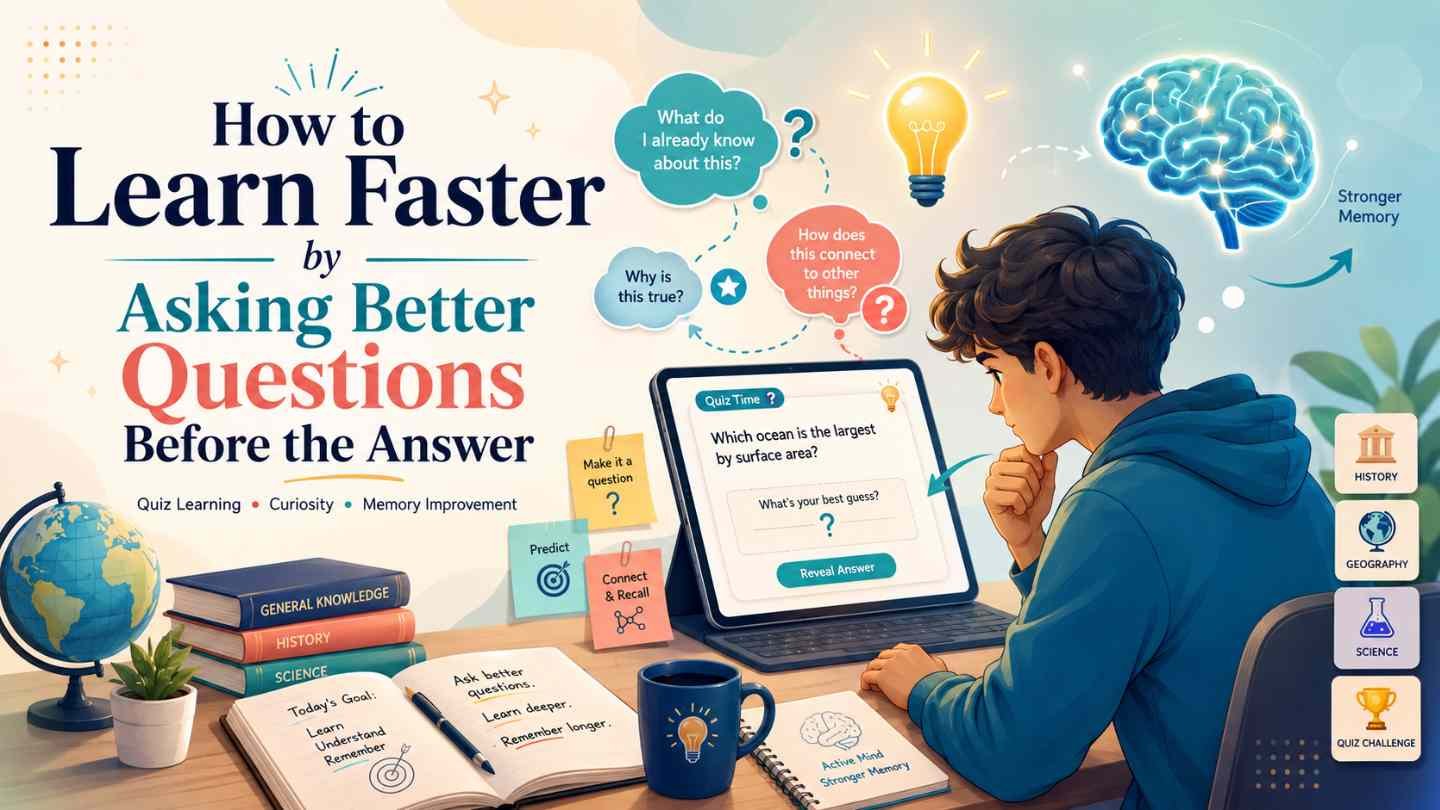
Many people take quizzes by rushing straight to the answer. They read the question, pick a choice, check if they were right, and move on. That feels quick, but it often misses the best learning moment.
The real power of quiz learning begins before you see the answer. That short pause gives your brain a chance to search, compare, predict, and wonder. When you start asking better questions, you turn a simple quiz into active learning.
Instead of only thinking, “What is the correct answer?” you begin asking, “Why would this be correct?” “What clue is hidden here?” “What do I already know about this topic?” That small shift helps you learn faster because your mind is no longer waiting passively. It is working.
Why the Question Before the Answer Matters
Before the answer appears, your brain is in discovery mode. You are not just receiving information yet. You are trying to build a path toward it.
That matters because memory becomes stronger when you make an effort first. Even if your guess is wrong, your brain has already created a place for the correct explanation to land. The answer feels more meaningful because you were actively searching for it.
For example, a quiz might ask:
Which planet has the most moons?
A rushed player might guess and move on. But a curious player may ask, “Is it Jupiter or Saturn?” “Did scientists recently discover more moons?” “Why do gas giants have so many?” Now the answer becomes part of a bigger idea, not just a trivia fact.
That is how asking better questions helps with memory improvement. You are not memorizing isolated answers. You are connecting facts to reasons, patterns, and context.
The Difference Between Answer-Hunting and Learning
Answer-hunting is when you only care about getting the item right. Learning is when you care about understanding why it is right.
There is nothing wrong with wanting a good score. Daily quizzes are fun because they give you quick feedback. But if the goal is to learn faster, the score should not be the only thing you notice.
A better approach is to treat every quiz question like a doorway. The answer tells you what is true, but your questions help you understand why it matters. That is where general knowledge grows from scattered facts into real understanding.
How to Ask Better Questions Before Choosing an Answer
1. Ask, “What is this question really testing?”
Some quiz questions are not only asking for a fact. They may be testing a concept, a timeline, a definition, or your ability to notice a clue.
For example, if a history quiz asks about an event, do not only look for the name. Ask what time period it belongs to, who was involved, and what changed afterward. This helps you see the bigger shape of the topic.
This simple question improves focus because it slows down careless guessing. It also trains you to read more carefully.
2. Ask, “What do I already know?”
Before checking the answer, pause and search your memory. Even a small clue can help.
You might remember a date, a country, a person, a word root, or a related fact. That tiny memory hook can guide you toward the answer. More importantly, it strengthens recall because you are practicing pulling information from your own mind.
This is one reason educational quizzes are useful. They do not just test what you know. They reveal what your brain can almost remember.
3. Ask, “Which answer choice feels familiar, and why?”
Familiarity can be helpful, but it can also trick you. Sometimes an answer looks right simply because you have seen the word before.
Instead of trusting the familiar choice immediately, ask why it feels familiar. Did you learn it in school? Did you see it in the news? Is it connected to another topic? This turns guessing into active learning.
A familiar-looking answer is not always correct, but it is still useful. It shows your brain has some connection to the topic.
4. Ask, “What would make the other choices wrong?”
This is one of the best ways to sharpen quiz learning. Instead of only looking for the right answer, test the wrong ones.
If a geography quiz asks about a capital city, ask whether the other choices belong to different countries. If a science quiz asks about an element, ask what category the other options belong to. This builds cleaner understanding because you are separating similar facts.
Learning becomes faster when your mind can explain the difference between close choices.
5. Ask, “What should I look up after this?”
Not every quiz question needs deep research. But some questions are perfect starting points for curiosity.
If a daily quiz asks about a famous invention, you might ask, “Who improved it later?” or “How did people live before it existed?” If a current events quiz mentions a leader, discovery, or sports record, ask what background would make the story clearer.
This turns quizzes into a daily learning habit. One question can lead to a useful article, a map, a timeline, or a short explanation.
For a fun starting point, you can try a daily quiz here: Bing Quiz Today.
Turning Quiz Questions Into Follow-Up Questions
A good follow-up question does not have to be complicated. It only needs to make the answer more meaningful.
Here are simple patterns you can use:
If the question asks “Who?”
Ask: “What did this person do, and why are they remembered?”
If the question asks “Where?”
Ask: “What makes this place important?”
If the question asks “When?”
Ask: “What happened before and after this event?”
If the question asks “What?”
Ask: “How does this thing work?”
If the question asks “Why?”
Ask: “What evidence or explanation supports it?”
These follow-up questions help move quiz learning from quick recognition to deeper understanding. You are not just collecting answers. You are building connections.
Practical Example: One Question, Better Learning
Imagine a quiz asks:
Which animal is the fastest land animal?
Most people know the answer is the cheetah. But asking better questions can still make the question useful.
You could ask:
Why is the cheetah so fast?
Its body is built for speed, with long legs, a flexible spine, and strong acceleration.
Can it run fast for a long time?
No. It can sprint quickly, but only for short distances.
What animal is fastest in the air or water?
Now the topic expands into birds, fish, and animal adaptations.
That one easy quiz question just became a mini-lesson in biology. This is how curiosity makes daily quizzes more powerful.
Why Better Questions Improve Memory
Memory improves when information has more “hooks.” A plain answer gives your brain one hook. A question, explanation, example, and comparison give your brain several.
That means you are more likely to remember the answer later. You may forget the exact wording of the quiz, but you remember the reason behind it. That is stronger than simply recognizing a correct option on the screen.
Asking better questions also helps with focus. When you are curious, your attention has a job. You are not just waiting for the result. You are actively trying to make sense of it.
How to Use This Method With Daily Quizzes
Daily quizzes work well because they are short. You do not need a long study session to practice active learning.
Before answering each question, take a small pause. Ask one quick question in your head. After checking the answer, ask one follow-up question if the topic seems interesting or confusing.
You can use this simple rhythm:
- Read the quiz question carefully.
- Ask what the question is really testing.
- Make your best answer.
- Check the result.
- Read or think about the explanation.
- Ask one follow-up question.
This keeps quiz learning light, but still meaningful. It also makes daily learning feel less like homework and more like discovery.
Better Questions for Wrong Answers
Wrong answers are not wasted. In many cases, they are the best learning shortcut.
When you miss a question, ask:
What made me choose the wrong answer?
Maybe the wording confused you. Maybe one choice looked familiar. Maybe you mixed up two similar facts.
What clue did I miss?
Quiz questions often contain hints in the wording. Paying attention to those clues helps you improve.
How can I explain the correct answer in one sentence?
If you can explain it simply, you are more likely to remember it.
This turns mistakes into memory improvement. Instead of feeling embarrassed by a wrong answer, you use it as a map.
Better Questions for Correct Answers
Correct answers deserve review too. Sometimes you get an answer right because you truly know it. Other times, you guess well.
After a correct answer, ask:
Did I know this, or did I just recognize it?
This helps you separate real recall from lucky familiarity.
Can I explain why it is correct?
If not, the answer may still need review.
What related fact would help me remember this better?
A related fact gives the answer more context.
This is important because a correct score does not always mean complete understanding. A quiz can show progress, but explanation makes the learning stronger.
A Balanced Note: Questions Help, But They Are Not Everything
Asking better questions can help you learn faster, but questions alone are not enough. Real understanding still needs explanation, review, and context.
A question opens the door. The answer gives direction. The explanation builds the lesson. Review helps the lesson stay in memory.
So do not stop at curiosity. Use curiosity as the beginning of learning, then strengthen it with clear explanations and repeated practice.
10 FAQs About Asking Better Questions for Quiz Learning
1. What does “asking better questions” mean?
It means thinking beyond “What is the answer?” and asking questions that help you understand the topic. Better questions look for reasons, clues, patterns, and connections.
2. How does asking questions help me learn faster?
It makes your brain active before the answer appears. This effort helps you focus, compare ideas, and remember the explanation more clearly.
3. Should I ask questions before every quiz answer?
You do not need to overdo it. Even one quick question before answering can improve your focus and make the quiz more useful.
4. What is a good question to ask before answering?
A simple one is: “What is this question really testing?” This helps you slow down and notice whether the question is about a fact, concept, date, person, or clue.
5. Can this method help with general knowledge?
Yes. General knowledge grows when facts connect to other facts. Asking follow-up questions helps you see those connections.
6. What should I do when I get a quiz answer wrong?
Ask why you chose the wrong answer, what clue you missed, and how you can explain the correct answer simply. This turns the mistake into useful learning.
7. What should I do when I get the answer right?
Ask whether you truly knew it or only recognized it. If you cannot explain the answer, spend a little time reviewing it.
8. Does this work for timed quizzes?
Yes, but keep it short. In a timed quiz, ask one fast question like, “What clue matters most?” or “Which choice can I eliminate?”
9. How do educational quizzes support active learning?
Educational quizzes give your brain a challenge, quick feedback, and a reason to review. When you add better questions, they become more than simple guessing games.
10. Can daily quizzes improve memory?
Yes, especially when you review the answers and ask follow-up questions. Daily quizzes help by giving your memory regular practice in small, manageable sessions.
Final Thoughts
Learning faster is not only about reading more, studying longer, or taking harder quizzes. Sometimes it starts with a better question asked at the right moment.
Before you check the answer, give your brain a chance to think. Ask what the question is testing, what you already know, why one choice makes sense, and what you should learn next. That small habit can turn ordinary quiz learning into active learning.
The answer gives you the fact. The better question helps you remember it.
Author

Althea is a contributing writer at bingquiz.weeklyquiz.net, specializing in trivia design and fact-checking across news, history, and pop culture. With a background in research and digital publishing, she focuses on crafting quizzes that are accurate, engaging, and easy to play. Her work is guided by a commitment to clarity, reliability, and providing readers with trustworthy knowledge in a fun format.
