
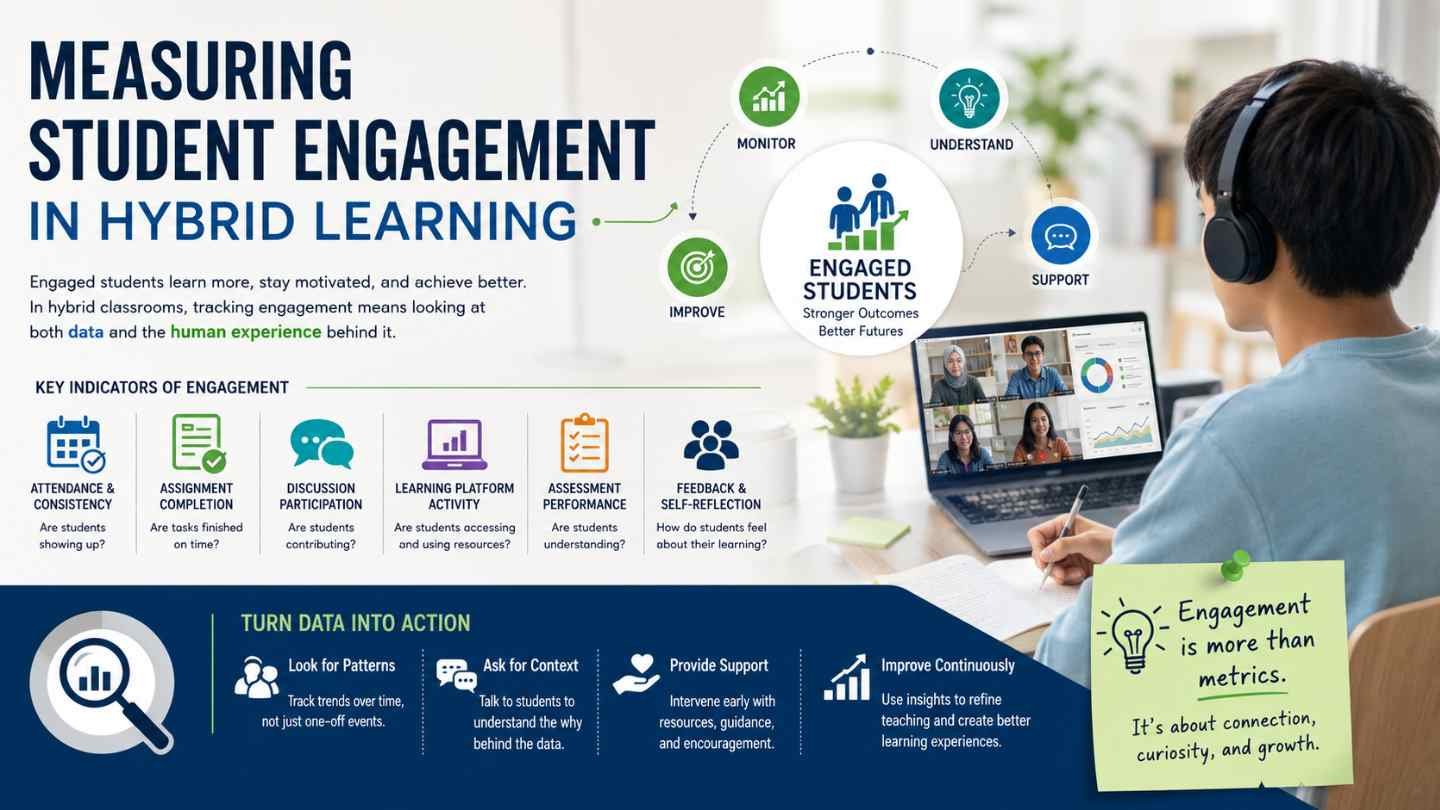
Student engagement has always been difficult to measure. A learner may sit quietly in the front row, submit every assignment, and still feel mentally detached from the lesson. Another may speak rarely but spend hours exploring a topic outside class. Hybrid learning makes these differences even harder to interpret because participation unfolds across physical classrooms, video meetings, learning platforms, group chats, assessments, and independent study.
For schools and teachers, the challenge is not simply collecting more data. Modern learning systems already generate an enormous amount of it. The real task is identifying which signals reveal genuine involvement and which merely record activity.
Measuring student engagement in hybrid learning therefore requires a broader approach. Attendance matters, but it is not enough. Login frequency can be useful, but it does not prove understanding. A strong measurement framework combines behavioral evidence, emotional feedback, academic performance, and the quality of student interaction.
What Is Student Engagement in Hybrid Learning?
Student engagement in hybrid learning describes the degree of attention, participation, curiosity, effort, and personal investment learners demonstrate across both online and face-to-face environments.
It is commonly viewed through three interconnected dimensions:
Behavioral Engagement
Behavioral engagement includes actions that can be observed or recorded. Examples include attending lessons, submitting assignments, completing quizzes, contributing to discussions, and participating in collaborative activities.
These indicators are relatively easy to measure. However, they can be misleading when examined alone. A student may log in every day without meaningfully interacting with the material.
Emotional Engagement
Emotional engagement concerns how students feel about their learning experience. Interest, confidence, belonging, enjoyment, frustration, anxiety, and boredom all influence whether a learner remains involved.
This dimension is more difficult to capture because emotions are not always visible. Students may appear cooperative while feeling overwhelmed or disconnected.
Cognitive Engagement
Cognitive engagement reflects the mental effort students invest in understanding a subject. It appears when learners ask thoughtful questions, connect ideas, revise their work, solve unfamiliar problems, or apply knowledge in new situations.
This is often the most meaningful form of engagement—and the hardest to reduce to a simple number.
Why Measuring Engagement in a Hybrid Classroom Is Difficult
In a traditional classroom, teachers can observe body language, eye contact, note-taking, conversations, and reactions in real time. Hybrid learning divides those signals across multiple settings.
A student who appears disengaged during a video lesson may be concentrating intensely while keeping the camera off. Another may appear attentive in class but rely heavily on classmates to complete group work. Some learners participate more freely online, while others become nearly invisible once a lesson moves to a digital platform.
Technical issues further complicate measurement. A missed session could indicate low motivation, an unstable internet connection, family responsibilities, or a scheduling conflict. Without context, the data may invite the wrong conclusion.
That is why effective engagement measurement should avoid treating a single behavior as definitive proof. Patterns matter more than isolated events.
Key Indicators of Student Engagement
A balanced approach combines several indicators rather than depending on one convenient metric.
Attendance and Consistency
Attendance remains an important starting point. Teachers can examine participation in physical classes, live online sessions, scheduled consultations, and required learning activities.
Consistency is often more informative than raw attendance. A learner whose participation gradually declines may need support even before grades begin to fall.
Still, attendance should be interpreted carefully. Being present does not necessarily mean being attentive, and absence does not always indicate indifference.
Assignment Completion
Submission rates can reveal whether students are keeping pace with the course. Useful measures include:
- Percentage of assignments completed
- Frequency of late submissions
- Number of missing tasks
- Changes in completion patterns
- Attempts made before final submission
A sudden increase in late or unfinished work may signal confusion, workload pressure, disengagement, or personal difficulty.
The quality of submissions matters as much as their completion. A rushed response submitted on time may show less engagement than a thoughtful assignment delivered a day late.
Participation in Discussions
Class discussions can expose levels of attention, understanding, and intellectual curiosity. In hybrid learning, participation may occur through spoken contributions, chat messages, discussion boards, shared documents, peer comments, or small-group activities.
Teachers should consider both frequency and substance. Ten shallow comments do not necessarily demonstrate more engagement than one carefully reasoned contribution.
Students also express themselves differently. Some think aloud. Others need time to process information before offering a response. A fair engagement model provides several ways to participate.
Learning Management System Activity
Learning management systems can track logins, page views, video completion, resource downloads, discussion activity, quiz attempts, and time spent on course materials.
These records help identify broad patterns. For example, a learner who stops opening weekly materials may be falling behind.
Yet digital activity data should never be mistaken for direct evidence of learning. A page left open for 40 minutes does not prove that the student read it. A completed video does not guarantee that the content was understood.
Analytics are clues, not verdicts.
Assessment Performance
Formative assessments offer valuable evidence of cognitive engagement. Short quizzes, reflection prompts, exit tickets, polls, and low-stakes exercises can reveal whether learners are following the lesson.
Interactive activities can make these checks feel less formal. A short knowledge game or a resource such as the bing weekly quiz may also encourage curiosity, recall, and regular participation when used appropriately alongside instructional content.
Teachers should pay attention not only to scores but also to improvement, repeated attempts, error patterns, and the willingness to revise an answer. Productive struggle often reveals deeper engagement than immediate correctness.
Collaboration and Peer Interaction
Hybrid learning depends heavily on communication. Students may collaborate in classrooms, breakout rooms, shared slides, discussion boards, peer-review activities, or messaging spaces.
Engagement can be assessed by examining whether learners:
- Contribute useful ideas
- Respond constructively to peers
- Complete their assigned roles
- Ask for clarification
- Help solve group problems
- Incorporate feedback into their work
Group participation should be evaluated with care. Quiet students may contribute through planning, research, editing, or technical support rather than public speaking.
Student Feedback and Self-Reflection
Students can often explain their own engagement more accurately than analytics can infer it. Short surveys and reflective questions give learners space to describe what is helping or hindering them.
Useful questions include:
- Which activity helped you understand the topic most clearly?
- At what point did you begin to feel confused?
- How confident are you about applying this concept?
- Did you feel comfortable participating this week?
- What made it difficult to complete the lesson?
- What could make the next activity more useful?
Anonymous feedback may produce more honest responses, especially when students are discussing stress, confidence, or classroom belonging.
Quantitative Methods for Measuring Engagement
Quantitative measures make it possible to track trends across classes, groups, or academic periods. Common examples include attendance percentages, submission rates, quiz scores, discussion counts, course completion, and platform activity.
A school might create a simple engagement dashboard showing:
| Indicator | Possible Measurement |
|---|---|
| Attendance | Percentage of sessions attended |
| Assignment completion | Percentage of required tasks submitted |
| Timeliness | Percentage submitted by the deadline |
| Discussion participation | Number of meaningful contributions |
| Assessment activity | Attempts, scores, and improvement |
| Platform use | Frequency and consistency of access |
| Collaboration | Peer or teacher evaluation scores |
Dashboards can help teachers notice changes quickly. They should not, however, be used to label students permanently. Engagement fluctuates according to topic difficulty, health, technology, personal circumstances, and the design of the lesson itself.
Numbers become more useful when they trigger a conversation rather than an automatic judgment.
Qualitative Methods for Understanding Engagement
Qualitative methods add meaning to the data. They help explain why a student’s participation changed and how the learner experiences the course.
Teachers can use observation notes, student interviews, focus groups, open-ended surveys, learning journals, portfolio reviews, and recorded reflections. These methods capture details that a dashboard cannot.
For instance, platform analytics may show that a student rarely contributes to live discussions. A private conversation might reveal that the learner is afraid of making grammatical mistakes in front of classmates. The solution is not to demand more public speaking immediately. It may be better to begin with written responses, paired discussions, or prepared contributions.
Qualitative evidence turns measurement into understanding.
Creating a Student Engagement Index
Some institutions combine several indicators into a student engagement index. This can make large amounts of information easier to monitor, especially in courses with many learners.
A basic model might assign weighted values to several areas:
- Attendance and consistency: 20%
- Assignment completion: 25%
- Formative assessment activity: 20%
- Discussion and collaboration: 20%
- Student reflection and feedback: 15%
The exact percentages should reflect the course. A laboratory class may place greater weight on practical participation, while a writing course may emphasize revision, discussion, and portfolio development.
Any engagement score must remain flexible and transparent. Students should know what is being measured, why the information is collected, and how it will be used. The index should support intervention—not function as a hidden disciplinary system.
How to Measure Engagement Without Encouraging Performative Participation
Poor measurement can cause students to focus on appearing active instead of learning. When teachers reward the number of comments, learners may post repetitive responses. When video attendance is treated as proof of engagement, students may remain visibly present while mentally checking out.
To avoid performative participation, educators should reward quality, growth, reflection, and meaningful contribution.
A student who asks a difficult question may demonstrate greater engagement than someone who answers five easy ones. A learner who revises weak work after receiving feedback may show more commitment than someone who submits a polished response without engaging further.
The measurement system should encourage authentic learning behaviors rather than visible busyness.
Practical Strategies for Teachers
Use Multiple Participation Channels
Allow learners to participate through speaking, writing, polling, drawing, collaborative editing, private reflection, and peer feedback. Variety creates a more accurate picture of engagement and makes participation accessible to different personalities.
Check Engagement Frequently
A large end-of-term survey arrives too late to solve most problems. Short weekly check-ins can reveal confusion, frustration, and declining motivation while there is still time to respond.
Even a one-question poll can be useful: “How confident are you about today’s lesson?” The value lies in noticing patterns and following up.
Separate Compliance From Learning
Completing a task does not always mean understanding it. Teachers should distinguish administrative compliance from intellectual engagement.
A submitted worksheet shows that work was turned in. A student’s explanation of why an answer is correct shows something deeper.
Look for Changes Over Time
Individual baselines matter. One student may participate verbally every day, while another usually contributes once per week. A sudden departure from a learner’s normal pattern is often more important than a comparison with classmates.
Engagement measurement should reveal movement: improving, declining, fluctuating, or remaining stable.
Contact Students Before Problems Escalate
Early outreach should feel supportive rather than punitive. A message such as “I noticed you have not completed the last two activities—has anything made the course difficult to access?” invites an honest response.
By contrast, assuming laziness may push an already disconnected student further away.
Evaluate the Course, Not Only the Learner
Low engagement is not always a student problem. It may indicate unclear instructions, repetitive activities, excessive workload, inaccessible technology, weak course organization, or lessons that feel unrelated to students’ goals.
When many learners disengage at the same point, the design deserves examination.
The Role of Technology in Engagement Measurement
Educational technology can streamline data collection, automate reminders, organize feedback, and identify learners who may need assistance. Artificial intelligence and learning analytics can also detect participation trends across large groups.
These tools should support professional judgment, not replace it.
Algorithms cannot fully understand unstable internet access, family obligations, cultural communication styles, disability-related needs, or emotional fatigue. They may also reinforce bias when a narrow definition of participation is treated as universal.
Technology is most useful when it helps teachers ask better questions. It becomes dangerous when it claims to provide complete answers about human motivation.
Student Privacy and Ethical Considerations
Engagement data can include attendance records, browsing behavior, assessment results, video participation, communication history, and personal feedback. Schools must handle this information responsibly.
Students should be told what information is collected, how long it will be stored, who can access it, and what decisions it may influence. Data collection should be limited to information that serves a clear educational purpose.
Teachers should also avoid intrusive monitoring. Tracking every click or demanding constant camera use may damage trust and create anxiety without improving learning.
The aim is to understand and support students—not to turn education into surveillance.
Signs That an Engagement Strategy Is Working
An effective engagement strategy does more than increase logins. It produces visible changes in how students approach learning.
Positive signs may include:
- More thoughtful questions
- Greater willingness to revise work
- Improved completion consistency
- Stronger peer interaction
- Better performance on unfamiliar problems
- Increased student confidence
- More specific feedback about lessons
- Reduced disappearance from online activities
- Stronger connections between classroom and independent work
The most encouraging sign is often ownership. Engaged students begin making decisions about how they learn, where they need help, and what they want to explore next.
Common Mistakes When Measuring Student Engagement
One common mistake is relying too heavily on attendance. Presence is useful, but it is only one part of engagement.
Another is assuming that frequent online activity equals learning. High click counts may reflect confusion, poor navigation, or repeated searching rather than focused study.
Schools may also compare students without considering differences in technology access, personality, language, disability, or home responsibilities. Such comparisons can produce unfair conclusions.
Finally, educators sometimes gather large amounts of data without acting on it. Measurement has little value when it does not lead to course improvements, student conversations, or timely support.
A Balanced Framework for Hybrid Learning
A practical engagement framework can follow five steps:
- Define meaningful engagement. Decide which behaviors and learning outcomes matter within the course.
- Collect varied evidence. Combine attendance, submissions, assessments, discussions, observations, and student feedback.
- Identify patterns. Look for changes over time rather than reacting to isolated incidents.
- Ask for context. Speak with students before deciding why participation has declined.
- Respond constructively. Adjust instruction, offer support, clarify expectations, or remove barriers.
This approach recognizes that engagement is not a fixed personality trait. It is a relationship between the learner, the material, the teacher, the technology, and the wider learning environment.
Conclusion
Measuring student engagement in hybrid learning requires more than counting attendance, clicks, or completed assignments. Those indicators provide useful information, but none can capture the full experience of a learner.
The strongest systems combine quantitative data with human observation, student reflection, academic evidence, and compassionate conversation. They examine the quality of participation, not just its visibility. They also recognize that declining engagement may reflect a barrier in the course rather than a lack of effort from the student.
Ultimately, engagement measurement should help educators notice who is connecting, who is struggling, and what needs to change. When used thoughtfully, it becomes less about monitoring students and more about creating conditions in which they can participate, understand, and grow.
Frequently Asked Questions
What is the best way to measure student engagement in hybrid learning?
The best approach combines multiple indicators, including attendance, assignment completion, formative assessments, discussion quality, collaboration, platform activity, and student feedback. No single metric gives a complete picture.
Is attendance a reliable measure of student engagement?
Attendance is useful but limited. A student can attend without actively learning, while another may miss a session for legitimate reasons and remain highly engaged through independent work.
How can teachers measure emotional engagement?
Teachers can use anonymous surveys, confidence scales, reflection journals, interviews, classroom observations, and regular check-ins to understand students’ interest, motivation, anxiety, and sense of belonging.
What digital tools can track student engagement?
Learning management systems, online quiz platforms, polling tools, discussion boards, video-conferencing reports, collaborative documents, and assessment software can all provide engagement data. Their records should be interpreted alongside qualitative evidence.
How often should student engagement be measured?
Engagement should be checked regularly throughout a course. Weekly or biweekly monitoring is often more useful than relying only on midterm or final evaluations because it allows teachers to respond before difficulties become severe.
Can student engagement be represented by a score?
It can be summarized through an engagement index, but the score should combine several indicators and remain open to context. It should be used as an early-warning and support tool, not as a permanent label or automatic basis for punishment.
Author

Althea is a contributing writer at bingquiz.weeklyquiz.net, specializing in trivia design and fact-checking across news, history, and pop culture. With a background in research and digital publishing, she focuses on crafting quizzes that are accurate, engaging, and easy to play. Her work is guided by a commitment to clarity, reliability, and providing readers with trustworthy knowledge in a fun format.
