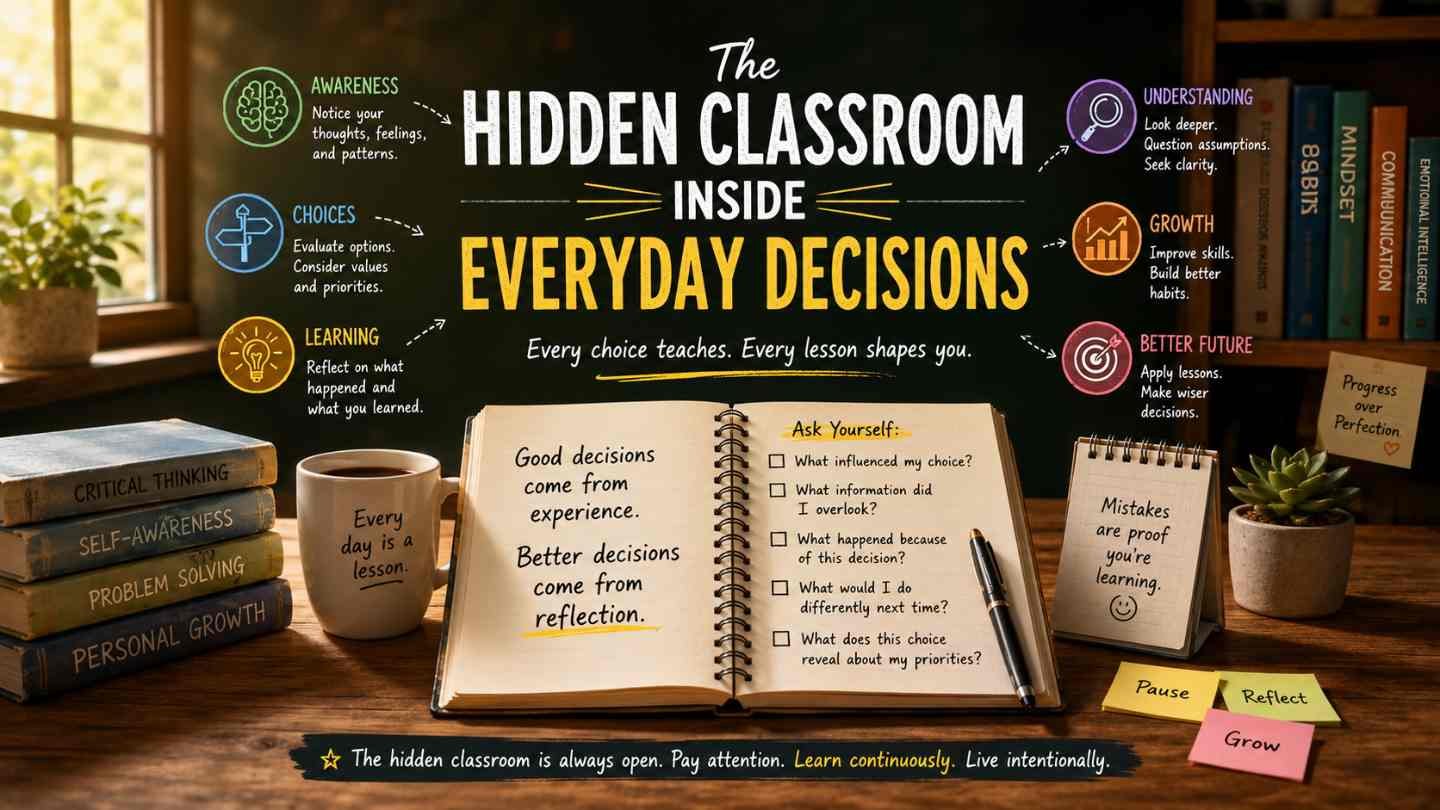
Every day, we make dozens of choices that seem too ordinary to count as learning. We decide whether to cook or order food, reply immediately or wait, buy the cheaper item or pay more for quality, and finish a task or postpone it. Yet each of these choices quietly teaches us something about judgment, priorities, consequences, and values.
This is the hidden classroom inside everyday decisions. It has no desks, exams, or formal lesson plans. Instead, it uses real situations to show us how we think, what we overlook, and how our actions shape what happens next.
The lessons are not always dramatic. Sometimes they appear as a small saving, an awkward conversation, a missed deadline, or the realization that a product was not as useful as expected. When we pay attention, ordinary decisions become a practical form of education that continues throughout life.
What Is the Hidden Classroom?
The hidden classroom is the learning environment created by daily life. It exists whenever a decision requires us to compare options, interpret information, manage emotions, accept uncertainty, or deal with consequences.
A grocery store can become a lesson in budgeting and nutrition. A difficult email can teach emotional control and communication. A busy afternoon can reveal whether we understand priorities or simply respond to whichever task feels most urgent.
Unlike formal education, this classroom rarely announces the lesson in advance. We often recognize what we learned only after the choice has been made.
The hidden classroom does not replace schools, books, teachers, or structured courses. It adds another layer to education by showing how knowledge and judgment operate in actual situations.
Learning Does Not Happen Only in Formal Lessons
Schools provide valuable foundations. Books introduce ideas we might never encounter on our own, while teachers help us understand complex subjects and avoid common misunderstandings. But education does not end when the lesson, semester, or course is over.
Real-life learning happens when knowledge meets circumstance. Knowing how interest works is useful, but deciding whether to use a credit card for an unnecessary purchase turns that knowledge into a practical judgment. Understanding nutrition matters, but choosing a meal when tired, rushed, and hungry reveals whether that understanding can guide behavior.
This is why experience can be such a powerful teacher. It places ideas inside situations where trade-offs are real and outcomes matter.
Even recreational activities can support this kind of learning. A well-designed entertainment knowledge challenge may encourage people to recall information, compare clues, and recognize gaps in what they know. Similarly, a bing interactive education quiz can turn general knowledge into an opportunity for active thinking rather than passive reading.
The Connection Between Everyday Decisions and Critical Thinking
Critical thinking is often discussed as though it belongs mainly to classrooms, debates, or complicated problems. In reality, people use it whenever they examine a claim, compare evidence, question an assumption, or consider possible consequences.
Imagine that you are deciding whether to buy a new phone. You may ask whether the upgrade offers features you genuinely need, whether online reviews are reliable, whether the price is likely to fall, and whether your current phone still performs well. That is critical thinking in an everyday setting.
The same process appears when choosing a news source, planning a route, deciding whom to trust, or evaluating advice. Each situation asks us to separate immediate impressions from stronger evidence.
Daily choices sharpen problem-solving skills because they force us to work with incomplete information. We rarely know every possible outcome. Good judgment is not about achieving perfect certainty; it is about making a reasonable choice while recognizing risks, limits, and alternatives.
What Small Choices Reveal About Us
Small decisions often expose patterns that large declarations hide. A person may say that saving money is important, yet repeatedly make unplanned purchases when stressed. Someone may value rest but feel guilty whenever they take a break. Another person may believe they handle conflict calmly while regularly sending replies before their emotions have settled.
These moments are not proof that someone is dishonest or incapable. They simply reveal the difference between intended priorities and practiced priorities.
Everyday choices can uncover:
- Habits we follow without noticing
- Assumptions we rarely question
- Situations that trigger emotional reactions
- Strengths we consistently rely on
- Blind spots that affect our judgment
- Values that guide us in practice
Self-awareness grows when we become curious about these patterns instead of immediately defending or condemning them.
Automatic Decisions Versus Reflective Decisions
Many daily choices must be made quickly. It would be exhausting to analyze every cup of coffee, every route to work, or every minor household task. Automatic thinking is not always a problem; it helps conserve mental energy.
The difficulty begins when important decisions are treated as though they are routine. We may accept a claim because it sounds familiar, buy something because it is discounted, or agree to a commitment before checking our schedule.
Reflective decision-making creates a small pause between impulse and action. That pause gives us time to ask what matters, what information is missing, and what consequences might follow.
Reflection does not require endless analysis. Sometimes ten thoughtful seconds are enough to prevent a choice that would create hours of difficulty later.
Everyday Decisions That Become Practical Lessons
Managing Money
Money decisions teach far more than arithmetic. They reveal how we respond to temptation, uncertainty, social pressure, delayed rewards, and financial risk.
Choosing between saving and spending can show whether we focus mainly on immediate satisfaction or future stability. Comparing prices teaches research skills, while reviewing monthly expenses can uncover habits that are easy to miss in individual transactions.
A financial mistake can also become useful data. An unnecessary subscription may teach the value of checking recurring charges. An impulse purchase may reveal which emotions or situations make spending harder to control.
Choosing What to Eat
Food choices involve health, cost, convenience, culture, pleasure, and time. The “best” option on paper may not be realistic in every situation, especially when someone is exhausted or managing a limited budget.
Everyday learning happens when we notice which meals provide steady energy, which habits lead to overspending, or how hunger affects judgment. Instead of treating each food choice as a moral success or failure, we can view it as information.
This approach encourages adjustment without unnecessary shame.
Planning Time
A daily schedule is a practical lesson in priorities. The way we allocate time often reveals what we protect, what we postpone, and what we underestimate.
Repeatedly missing deadlines may point to poor planning, but it could also reveal unrealistic expectations, unclear instructions, or difficulty saying no. Finishing many small tasks while avoiding one important project may show that busyness has become a substitute for progress.
Time management improves when we study why plans fail rather than merely creating stricter plans.
Responding to Conflict
Conflict turns an ordinary conversation into a lesson about emotion, perspective, and communication. A quick reply may feel satisfying but create a larger problem. Avoiding the issue may preserve temporary peace while allowing resentment to grow.
A thoughtful response requires us to separate what was said from what we assumed was meant. It also asks whether our goal is to solve the problem, protect the relationship, defend ourselves, or simply prove that we are right.
These decisions can teach patience, boundary-setting, empathy, and clarity.
Buying Products
Buying decisions teach us to compare quality, price, durability, convenience, and long-term value. Advertising often directs attention toward what is exciting while leaving limitations in the background.
Reading reviews can help, but it also requires judgment. Some reviews reflect genuine use, while others may be biased, overly emotional, or based on needs different from our own.
A careful buyer learns to ask not only, “Is this product good?” but also, “Is it suitable for my situation?”
Using Technology
Technology choices shape attention, privacy, productivity, and relationships. A notification may seem minor, yet repeated interruptions can weaken concentration. A convenient app may collect more personal data than expected.
The hidden classroom appears when we notice how tools influence behavior. Are we using technology intentionally, or are its default settings directing our time?
Learning to adjust notifications, verify permissions, organize files, and set boundaries around screen use builds practical digital judgment.
Evaluating News and Online Information
Every headline presents a decision: believe it, ignore it, question it, or investigate further. Online information can spread quickly because it triggers emotion before giving readers time to evaluate evidence.
Critical thinking involves checking the source, publication date, supporting evidence, and original context. It also means noticing whether a claim confirms something we already want to believe.
The goal is not to become suspicious of everything. It is to develop a healthy habit of verification, especially when information is surprising, emotionally charged, or likely to be shared with others.
Helping Other People
Helping someone can teach compassion, responsibility, and discernment. Good intentions matter, but effective help also requires understanding what the other person actually needs.
Sometimes assistance means offering time or resources. In other situations, it means listening, teaching a skill, setting a boundary, or allowing someone to solve a problem independently.
Reflecting on these choices helps us distinguish between support that empowers and help that accidentally creates dependence.
Balancing Work, Rest, and Responsibilities
The choice to continue working or take a break often reveals beliefs about productivity and self-worth. Some people rest too quickly when a task becomes uncomfortable. Others continue far beyond the point where their concentration and judgment have declined.
Balance is not achieved by giving equal time to everything each day. It comes from recognizing changing needs and making deliberate trade-offs.
A demanding week may require extra effort, while sustained performance may depend on protecting sleep, relationships, and recovery.
A Mini-Example: The Cheaper Product That Cost More
Suppose someone needs a new desk chair. They find one online for half the price of several better-known alternatives. The product photos look convincing, and the discount ends that evening, so they order it without much research.
Within two months, the seat becomes uncomfortable and one of the adjustment controls breaks. The buyer now needs either to repair the chair or purchase another one.
At first, the lesson may appear simple: cheap products are bad. But that conclusion is too broad. The more useful lesson comes from examining the whole decision.
The buyer may realize that the countdown timer created urgency, the low price overshadowed questions about durability, and the positive reviews were based mostly on first impressions rather than long-term use. They may also recognize that they never checked the warranty or calculated the cost of replacing a poor-quality product.
This one decision teaches several connected lessons:
- Research matters more when a product will be used frequently.
- A discount can influence judgment even when the item is not truly good value.
- Risk depends on the consequences of failure.
- Reviews should be evaluated according to duration and relevance.
- The cheapest initial price is not always the lowest total cost.
The goal is not to regret the purchase forever. It is to use the experience to create a better process for the next decision.
How Mistakes Become Useful Lessons
Mistakes can teach us, but only when we examine them honestly. Replaying an error repeatedly without gaining new understanding is not reflection. It is rumination.
A constructive review asks what information was available at the time, what assumptions shaped the choice, and what could reasonably be changed in the future. It avoids pretending that the correct answer should always have been obvious.
Not every bad outcome proves that the decision was foolish. A careful decision can still lead to an unfortunate result because uncertainty is part of life. Likewise, a careless decision can produce a good outcome through luck.
The lesson should therefore focus on the quality of the process, not only the final result.
Shame says, “I made a poor choice because something is wrong with me.” Learning says, “This choice exposed a weakness in my process, and I can improve it.”
Repeated Decisions Shape Character and Outcomes
A single decision rarely defines a person. Repeated choices, however, gradually create habits, abilities, and expectations.
Choosing to verify information strengthens intellectual discipline. Practicing calm responses during conflict improves emotional control. Setting aside a small amount of money regularly builds financial stability. Protecting time for focused work develops reliability.
Character is often formed through ordinary repetition rather than dramatic moments. Patience grows through many small pauses. Courage grows through repeated willingness to face manageable discomfort. Responsibility grows when commitments are honored even when enthusiasm fades.
Long-term outcomes are similarly cumulative. A five-minute delay may not matter once, but habitual postponement can affect work, health, finances, and relationships. Small decisions gain power through repetition.
Curiosity Makes Everyday Learning Deeper
Curiosity changes the tone of reflection. Instead of asking, “Why do I always get this wrong?” we can ask, “What keeps influencing me in this situation?”
That shift reduces defensiveness and opens the door to useful discoveries. Perhaps we make worse decisions when rushed. Maybe we accept claims more easily when they come from familiar people. We might discover that certain tasks are delayed because the first step is unclear rather than because we lack discipline.
Curiosity also encourages us to explore alternatives. What would happen if we changed the timing, environment, information source, or decision rule?
A curious person does not need every experience to confirm what they already believe. They are willing to let ordinary life correct them.
Questions to Ask After Making a Decision
Reflection becomes easier when it is guided by specific questions. After a meaningful choice, ask:
What influenced my choice?
Consider emotions, habits, advice, advertising, time pressure, fear, convenience, and social expectations.
What information did I overlook?
Think about facts you did not know, details you ignored, or questions you failed to ask.
What happened because of this decision?
Look at immediate results as well as delayed effects on your time, money, health, work, or relationships.
What would I do differently next time?
Choose a realistic adjustment rather than imagining a perfect response.
What does this choice reveal about my priorities?
Compare the values you claim to hold with the priorities demonstrated by your actions.
A Step-by-Step Method for Learning From One Ordinary Decision
Step 1: Choose a Recent Decision
Select something specific and manageable. It could be a purchase, a delayed task, a meal, a difficult reply, or the way you spent an hour.
Step 2: Reconstruct the Situation
Write down what was happening at the time. Include your options, available information, emotional state, and any pressure you felt.
Step 3: Identify the Main Influence
Determine what carried the most weight. Was it convenience, fear, price, habit, urgency, fatigue, or another person’s opinion?
Step 4: Compare Expectation With Outcome
What did you expect to happen, and what actually happened? The difference often contains the lesson.
Step 5: Extract One Practical Insight
Avoid turning one experience into a sweeping rule. State one lesson that is narrow enough to be useful.
For example: “When buying something I will use daily, I should check long-term reviews and warranty terms before focusing on price.”
Step 6: Create a Small Future Action
Decide how the lesson will affect your next similar choice. A lesson becomes valuable when it changes a process, question, habit, or boundary.
A Five-Minute Reflection Activity
Choose one decision you made today and set a timer for five minutes.
For the first minute, describe the choice without judging it. During the second minute, list the factors that influenced you. Use the third minute to identify the result or likely consequence.
During the fourth minute, write one thing you handled well and one thing you might improve. In the final minute, create a simple rule or reminder for the future.
Your completed reflection might look like this:
I delayed starting a report because the task felt too large. I spent time on smaller jobs that gave me a quick sense of progress. The delay created more pressure later. Next time, I will define the first ten-minute step before switching to easier work.
This activity is brief enough to use regularly without turning daily life into a constant self-evaluation project.
Advice for Different Types of Learners
For Students
Connect academic ideas to real decisions. Budgeting can make mathematics more concrete, comparing news reports can improve source evaluation, and planning assignments can teach project management.
Do not measure learning only by grades. Notice how your decisions improve as your understanding grows.
For Parents
Children learn from the reasoning adults model. When appropriate, explain why you compare prices, verify information, apologize after a mistake, or change a plan.
Avoid turning every choice into a lecture. A thoughtful question often teaches more than an immediate correction.
For Teachers
Use familiar decisions to make abstract concepts meaningful. Lessons about probability, persuasion, nutrition, economics, and ethics become easier to understand when connected to situations students recognize.
Invite students to examine decision processes rather than rewarding only correct answers.
For Professionals
Review not only what succeeded or failed, but how decisions were made. Examine assumptions, communication gaps, incentives, timing, and risk.
Workplace experience becomes more valuable when lessons are captured instead of repeatedly rediscovered.
For Lifelong Learners
Treat ordinary life as a source of questions. Read, research, and seek expert guidance when a daily experience reveals a gap in your understanding.
You do not need to enroll in a formal course every time you want to grow. Sometimes learning begins by paying closer attention to a decision you already make.
Common Mistakes to Avoid
Overthinking Minor Choices
Not every decision deserves a detailed analysis. Spending twenty minutes choosing between two nearly identical household items may consume more energy than the choice is worth.
Match the depth of reflection to the importance, cost, and reversibility of the decision.
Judging Yourself Too Harshly
Reflection should produce clarity, not punishment. Harsh self-criticism can make people defensive and less willing to examine their choices honestly.
Describe the behavior precisely without turning it into a permanent statement about your identity.
Confusing Hindsight With Wisdom
Once an outcome is known, the better choice may appear obvious. But decisions must be evaluated using the information available at the time.
Wisdom comes from improving the future process, not pretending the past was completely predictable.
Creating Rules From One Experience
One disappointing purchase does not prove that every inexpensive product is poor quality. One uncomfortable conversation does not mean honesty always damages relationships.
Look for patterns across several experiences before forming broad conclusions.
Reflecting Without Changing Anything
Insight alone can feel productive, but learning remains incomplete when it never affects behavior. Turn each useful lesson into a question, reminder, boundary, checklist, or small action.
The Lessons Are Already Around You
The hidden classroom inside everyday decisions is always open. It appears while managing money, planning time, choosing food, evaluating information, navigating conflict, and deciding when to work or rest.
Its lessons are easy to miss because they arrive disguised as ordinary life. Yet these small experiences steadily develop judgment, self-awareness, critical thinking, and problem-solving skills.
You do not need to analyze every choice or demand perfection from yourself. Begin by noticing one meaningful decision each day. Ask what influenced it, what followed, and what you might carry into the next similar situation.
Education is not limited to what we study. It also grows from how carefully we observe the lives we are already living.