
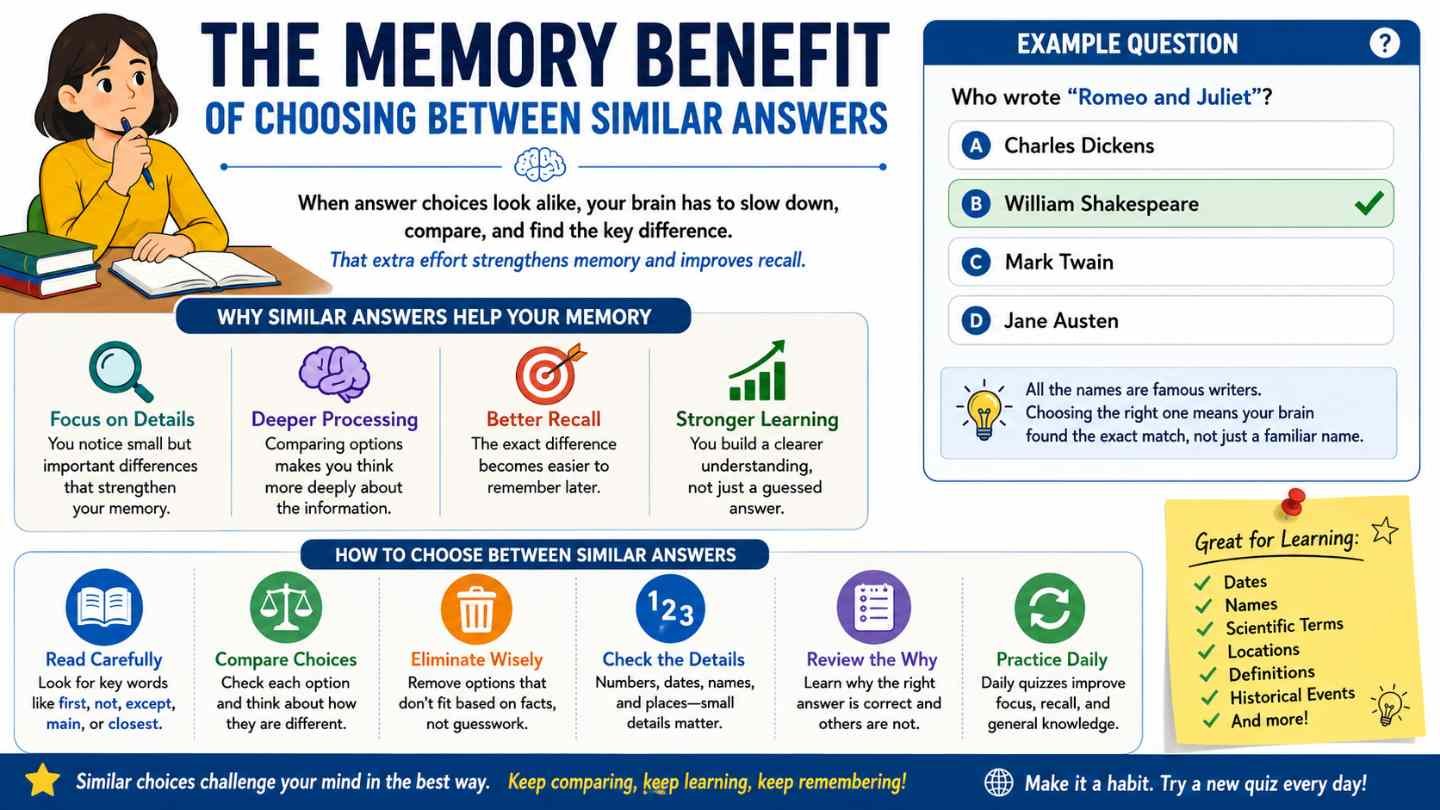
Some quiz questions feel easy until you look at the answer choices. Two options seem almost identical, both sound familiar, and either one could be correct at first glance. That moment of uncertainty may feel frustrating, but it can also be one of the most useful parts of quiz learning.
Choosing between similar answers forces your mind to do more than recognize a familiar word. You have to search for the exact date, definition, name, location, or scientific detail that separates the correct option from a convincing near-match. That small act of comparison can make the final answer far more memorable than a choice that was obvious immediately.
The real memory benefit does not come from simply getting the question right. It comes from identifying the tiny distinction that made one answer right and the other one wrong.
Similar Answers Turn Memory Into a Difference Detector
Memory is often discussed as though it were a filing cabinet where facts are stored separately. In practice, many facts overlap. Historical figures lived during similar periods, countries share borders and cultural features, and scientific terms may differ by only one word.
When answer choices are clearly different, recognition may be enough. You see the familiar option, select it, and move on without thinking deeply. Similar choices interrupt that automatic response and make you inspect what you actually know.
For example, imagine this question:
Which year did the Berlin Wall fall?
- 1987
- 1989
- 1991
- 1993
Several dates belong to the same general period, so knowing that the event happened “near the end of the Cold War” is not enough. You must recall the specific year: 1989. That extra precision helps the date become attached more firmly to the event.
Why Small Differences Can Create Stronger Memories
The brain tends to remember information better when it has been examined, compared, and connected to something meaningful. Similar answer choices naturally encourage this kind of mental work because they create a useful question: “What exactly makes these two options different?”
That question directs attention toward the detail most likely to be forgotten. Instead of storing a vague impression, you begin building a clearer boundary between related facts.
Consider the difference between these two statements:
- The Amazon River is the longest river in the world.
- The Amazon River carries the greatest volume of water.
The first statement is debated depending on how river length is measured, while the second is widely accepted. A carefully written quiz can help readers separate two ideas that are often blended together. The distinction becomes easier to recall because the learner has actively compared them.
Recognition Is Not the Same as Precise Recall
Recognition happens when an answer looks familiar. Precise recall happens when you can retrieve the detail that proves why it is correct.
In many multiple-choice quizzes, a familiar-looking option can create false confidence. A reader may recognize a name without remembering whether that person was a scientist, an inventor, a ruler, or an explorer. Similar answers reveal whether the knowledge is specific or merely familiar.
Suppose a question asks who developed the theory of general relativity:
- Albert Einstein
- Isaac Newton
- Niels Bohr
- Ernest Rutherford
All four names belong to science, so choosing correctly requires more than recognizing a famous scientist. You must connect Albert Einstein specifically with general relativity. That connection is more useful than simply knowing his name.
How Similar Answer Choices Improve Focus
Similar choices make careless reading less rewarding. A single word, number, location, or phrase may determine the answer, so readers have to slow down and inspect the question properly.
This can improve focus in two directions. First, you pay closer attention to the wording of the question. Second, you examine each option instead of selecting the first one that seems related.
For instance, there is a major difference between these questions:
- Which country contains Mount Kilimanjaro?
- Which country is nearest to Mount Kilimanjaro?
- Which country can Mount Kilimanjaro be seen from?
The answer to the first question is Tanzania, but nearby Kenya may appear as a tempting choice. Careful reading prevents geographical familiarity from replacing accurate knowledge.
Practical Examples of Similar Answers
The value of similar choices becomes clearer when we look at the kinds of distinctions educational quizzes can test.
Dates That Belong to the Same Period
Historical dates are difficult because several important events may occur within a short span of time. Similar answer choices help learners place events more accurately on a timeline.
Example: When did World War II end?
- 1944
- 1945
- 1946
- 1947
The years are close enough that guessing from the general decade is not sufficient. Remembering 1945 gives the event a precise place in history.
A useful review would go one step further by noting that the war ended in Europe in May 1945, while Japan formally surrendered in September 1945. This extra context makes the date easier to retain.
Names From the Same Field
Names become confusing when several people are associated with the same subject. Scientists, writers, rulers, artists, and explorers are especially easy to mix up.
Example: Who discovered penicillin?
- Alexander Fleming
- Louis Pasteur
- Robert Koch
- Joseph Lister
Every option is connected with medicine or microbiology. The correct answer, Alexander Fleming, becomes more memorable when the other names are briefly reviewed rather than ignored.
Pasteur is associated with germ theory and pasteurization, Koch with disease-causing microorganisms, and Lister with antiseptic surgery. Comparing the names gives each person a clearer mental label.
Scientific Terms With Related Meanings
Science knowledge often depends on understanding closely related terms rather than memorizing isolated definitions.
Example: What process allows plants to release water vapor through their leaves?
- Respiration
- Transpiration
- Photosynthesis
- Germination
All four are genuine biological processes, but only transpiration refers specifically to the release of water vapor from plant leaves. Choosing correctly requires matching the exact process to its definition.
This kind of comparison can produce better memory improvement because it builds a small network of related concepts. You are not only learning what transpiration means; you are also learning what it is not.
Locations That Are Geographically Close
Geography questions frequently use neighboring countries, nearby cities, or similar place names. These options challenge readers to move beyond a rough sense of location.
Example: Bratislava is the capital of which country?
- Slovenia
- Slovakia
- Croatia
- Serbia
The countries are all in the same broad region, and Slovenia and Slovakia are often confused because of their similar names. The correct answer is Slovakia.
A quick memory link can help: Bratislava lies on the Danube and is close to both Austria and Hungary. Adding that geographical context makes the capital easier to remember than repeating the answer alone.
Definitions That Differ by One Key Detail
Definitions can look almost identical while describing different ideas. Similar answers encourage readers to locate the deciding phrase.
Example: Which definition best describes evaporation?
- Water vapor changing into liquid
- Liquid water changing into vapor
- Ice changing directly into vapor
- Liquid water becoming solid
The correct answer is liquid water changing into vapor. The other options describe condensation, sublimation, and freezing.
Here, quiz learning becomes more efficient because one question helps clarify four related processes. The reader learns the family of terms rather than memorizing evaporation in isolation.
Historical Events With Related Causes or Outcomes
Events from the same period may share leaders, locations, causes, or political consequences. Similar choices can help separate them.
Example: Which event began with the storming of the Bastille?
- The American Revolution
- The French Revolution
- The Russian Revolution
- The Industrial Revolution
The word “revolution” makes every option seem connected, but only the French Revolution is linked to the storming of the Bastille in 1789.
A helpful explanation adds the missing relationship: the Bastille was a prison and symbol of royal authority in Paris. That detail gives the event a scene, a place, and a meaning.
Similar Choices Encourage Active Recall
Multiple-choice questions are sometimes criticized because the correct answer is visible on the page. However, the learning value changes when readers try to recall the answer before examining the choices.
A useful routine is to cover or ignore the options for a moment and answer from memory. After forming an initial response, compare it with the available choices. Similar answers then become a checking tool rather than a collection of clues used for guessing.
This method combines recall practice with careful comparison. You first retrieve the fact independently, then test whether your memory is precise enough to distinguish it from related possibilities.
How to Compare Similar Answers More Effectively
Choosing between near-matches becomes easier when you use a deliberate process instead of staring at the options and hoping one feels right.
Identify What Category the Question Is Testing
Before comparing choices, decide what kind of detail the question requires. Is it asking for a date, person, location, definition, cause, title, measurement, or sequence?
This prevents unrelated knowledge from interfering. A question may mention a famous scientist, for example, but actually ask for the name of a theory rather than the person who proposed it.
Look for the Deciding Word
Many difficult questions contain one word that changes the entire task. Words such as first, largest, official, modern, former, nearest, and primary deserve special attention.
Suppose a quiz asks for the “largest desert in the world.” Someone thinking only of hot deserts may choose the Sahara. But because Antarctica is classified as a desert based on its low precipitation, it is the largest desert overall.
Careful reading is often more valuable than faster recall.
Describe Each Choice in Your Own Words
When two answer choices seem equally likely, briefly explain what each one means. This reveals whether you truly understand the options.
For example, if the choices are “weather” and “climate,” you might remind yourself:
- Weather describes short-term atmospheric conditions.
- Climate describes long-term patterns in a region.
Once the difference is stated clearly, the correct choice usually becomes easier to see.
Eliminate Near-Matches for a Specific Reason
Do not reject an option merely because it “does not feel right.” Give yourself a reason.
You might say, “That person lived during the correct century, but was associated with a different discovery,” or “That city is in the correct country, but it is not the capital.” Specific elimination strengthens memory because it clarifies the role of the incorrect option.
Check Numbers Digit by Digit
Dates, distances, temperatures, percentages, and measurements are easy to misread. Similar numerical choices should be compared slowly.
Look for reversed digits, nearby decades, different units, and misplaced decimal points. A learner who remembers “around 1770” may still need to distinguish 1773 from 1776. The comparison reveals the exact part of the fact that needs review.
How to Handle an Answer That Is Almost Correct
Near-matches are useful because they expose incomplete knowledge. You may know the right country but choose the wrong city, remember the correct scientist but select the wrong discovery, or recall the event while missing its date.
Instead of treating the mistake as a total failure, identify the part you did know. Then locate the missing detail.
For example:
- What you knew: Marie Curie was connected with radioactivity.
- What you confused: Whether she discovered radium, polonium, or both.
- What to remember: Marie and Pierre Curie discovered both polonium and radium in 1898.
This style of correction is more productive than copying the answer several times. It repairs the exact weakness that caused the mistake.
Review the Confusing Option, Not Just the Correct One
A common quiz habit is to check the correct answer and immediately continue. That may be enough for scoring, but it misses a valuable learning opportunity.
When two similar answers caused confusion, review both of them. Write or say one sentence explaining how they differ.
For example:
- Latitude measures distance north or south of the equator.
- Longitude measures distance east or west of the prime meridian.
The comparison creates a cleaner memory boundary. The next time those terms appear, you are less likely to rely on a vague feeling of familiarity.
Build Small “Difference Pairs”
One practical way to improve general knowledge is to collect pairs of ideas you often confuse. These may include:
- Austria and Australia
- Affect and effect
- Astronomy and astrology
- The Arctic and Antarctica
- Parliament and Congress
- Weather and climate
- A comet and an asteroid
For each pair, write the smallest meaningful difference between them. The goal is not to create a long textbook explanation. A short contrast is usually easier to retrieve during daily quizzes.
For instance: “The Arctic is mainly an ocean surrounded by land, while Antarctica is a continent surrounded by ocean.” One clear comparison can replace several disconnected facts.
How Daily Quizzes Strengthen These Distinctions
Daily quizzes provide repeated opportunities to meet familiar topics in slightly different forms. One day a question may ask for the capital of Slovakia. Another may ask which river flows through Bratislava or which countries border Slovakia.
This repeated contact helps knowledge become flexible. Instead of remembering one answer in one fixed question, you begin understanding how the fact connects with other information.
Regular educational quizzes can therefore support memory improvement when they include clear explanations and varied recall practice. A site such as Bing Quiz can be used as part of a daily learning routine in which readers answer, check, compare, and review.
The strongest approach is not to race through as many questions as possible. It is to pause whenever two choices seem confusing and turn that uncertainty into a useful comparison.
Similar Answers Can Improve Careful Reading
The memory benefit of similar answers is closely connected with reading accuracy. A reader who overlooks a word such as “not,” “except,” or “earliest” may choose an option that is factually true but does not answer the actual question.
Fair multiple-choice quizzes reward attention rather than suspicion. Their similar choices should represent believable misunderstandings, not hidden traps.
For example, asking which planet is “closest to the Sun” fairly distinguishes Mercury from Venus. Asking the same question with vague wording or two defensible interpretations would not strengthen learning. It would simply create uncertainty about what the writer intended.
When Similar Choices Become Misleading
Similar answer choices are useful only when the question has one clearly defensible answer. Well-designed options test meaningful distinctions. Poorly designed options rely on ambiguity, obscure wording, or technical loopholes.
A confusing trick answer may make readers remember the frustration rather than the fact. It can also teach them to overanalyze simple questions or search for hidden meanings that are not there.
Good quiz writing should follow three basic principles:
- The question should provide enough information to identify one correct answer.
- Incorrect choices should be believable but demonstrably wrong.
- The explanation should clarify why the correct answer wins.
When these conditions are met, similar answers encourage focus and stronger thinking. When they are not, they may weaken trust in the quiz.
A Simple Review Method for Confusing Choices
After completing a quiz, return to every question where you hesitated between two options. Use this four-step review:
1. Name the Two Choices
Write down the correct answer and the near-match that tempted you.
2. State the Difference
Explain the distinction in one clear sentence.
3. Add One Memory Anchor
Connect the correct answer with a date, location, image, cause, word clue, or related fact.
4. Test Yourself Later
Ask the same question again without looking at the choices.
For example:
- Confusing pair: Magma and lava
- Difference: Magma is molten rock below Earth’s surface; lava is molten rock after it reaches the surface.
- Memory anchor: Lava is what flows visibly from a volcano.
- Later test: What is molten rock called while it remains underground?
This method transforms a moment of uncertainty into a compact memory lesson.
Do Harder Choices Always Produce Better Learning?
Not necessarily. Difficulty helps only when it directs attention toward an important distinction.
Four random or extremely obscure answer choices may make a question harder without making it educational. In contrast, two closely related choices can be valuable when their difference represents a common misunderstanding.
The ideal level of challenge sits between obvious and unfair. Readers should need to think, but they should also be able to understand the answer after reading the explanation.
Using Similar Answers Without Becoming Overcautious
Once readers become aware of near-matches, they sometimes begin doubting every answer. They may replace a strong first response with a weaker choice simply because the second option looks more technical.
To avoid this, separate evidence from anxiety. Ask yourself what fact supports your answer rather than whether another choice merely sounds impressive.
A useful rule is: change your answer only when you can identify a specific reason the first choice is wrong. Do not switch simply because two options feel similar.
Frequently Asked Questions
1. Why are similar answers useful in multiple-choice quizzes?
They force readers to notice the exact detail that separates closely related facts. This encourages deeper comparison instead of simple recognition or guessing.
2. Can similar answer choices improve memory?
Yes, especially when readers explain why one option is correct and the other is not. The act of comparing related ideas can create clearer memory boundaries.
3. Why do I confuse two answers even when I studied the topic?
You may remember the general category without recalling the defining detail. For example, you might know that two people were scientists but forget which discovery belongs to each person.
4. Should I read the answer choices before trying to recall the answer?
For stronger recall practice, try answering the question from memory first. Then use the choices to verify your response and compare it with nearby alternatives.
5. What is the best way to eliminate a near-match?
State a specific reason it does not fit the question. Identify the incorrect date, definition, location, role, measurement, or relationship instead of rejecting it by instinct.
6. Why are similar dates difficult to remember?
Dates from the same period share the same historical context, so they can blend together. Connecting each date with a particular event, place, or sequence makes it easier to distinguish.
7. Can reviewing wrong answers help with general knowledge?
Yes. Wrong answers often represent related facts worth knowing. Reviewing them can turn one quiz question into a small lesson covering several connected ideas.
8. Are trick answers good for quiz learning?
Only when the distinction is fair, relevant, and clearly explained. Misleading wording or multiple defensible answers can create confusion instead of useful learning.
9. How often should I review confusing answer choices?
Review them soon after the quiz, then test yourself again after a day or several days. Spacing the review helps determine whether the distinction has entered long-term memory.
10. Can daily quizzes improve recall even when I make mistakes?
Yes. Mistakes reveal where your knowledge is vague or incomplete. When you compare the confused options and study the difference, the correction can become more memorable than an answer you knew immediately.
Final Thoughts
The hardest part of a quiz question is often not recognizing the topic. It is choosing between two answers that both seem close enough to be right. That hesitation exposes the boundary between vague familiarity and dependable knowledge.
Well-written similar answers train the mind to notice that boundary. They encourage careful reading, sharper focus, precise recall, and a better understanding of how related facts differ.
The next time two choices appear almost identical, do not treat the moment as an annoying obstacle. Pause and identify the detail that separates them. That tiny difference may become the part of the lesson you remember longest.
Author

Althea is a contributing writer at bingquiz.weeklyquiz.net, specializing in trivia design and fact-checking across news, history, and pop culture. With a background in research and digital publishing, she focuses on crafting quizzes that are accurate, engaging, and easy to play. Her work is guided by a commitment to clarity, reliability, and providing readers with trustworthy knowledge in a fun format.
