
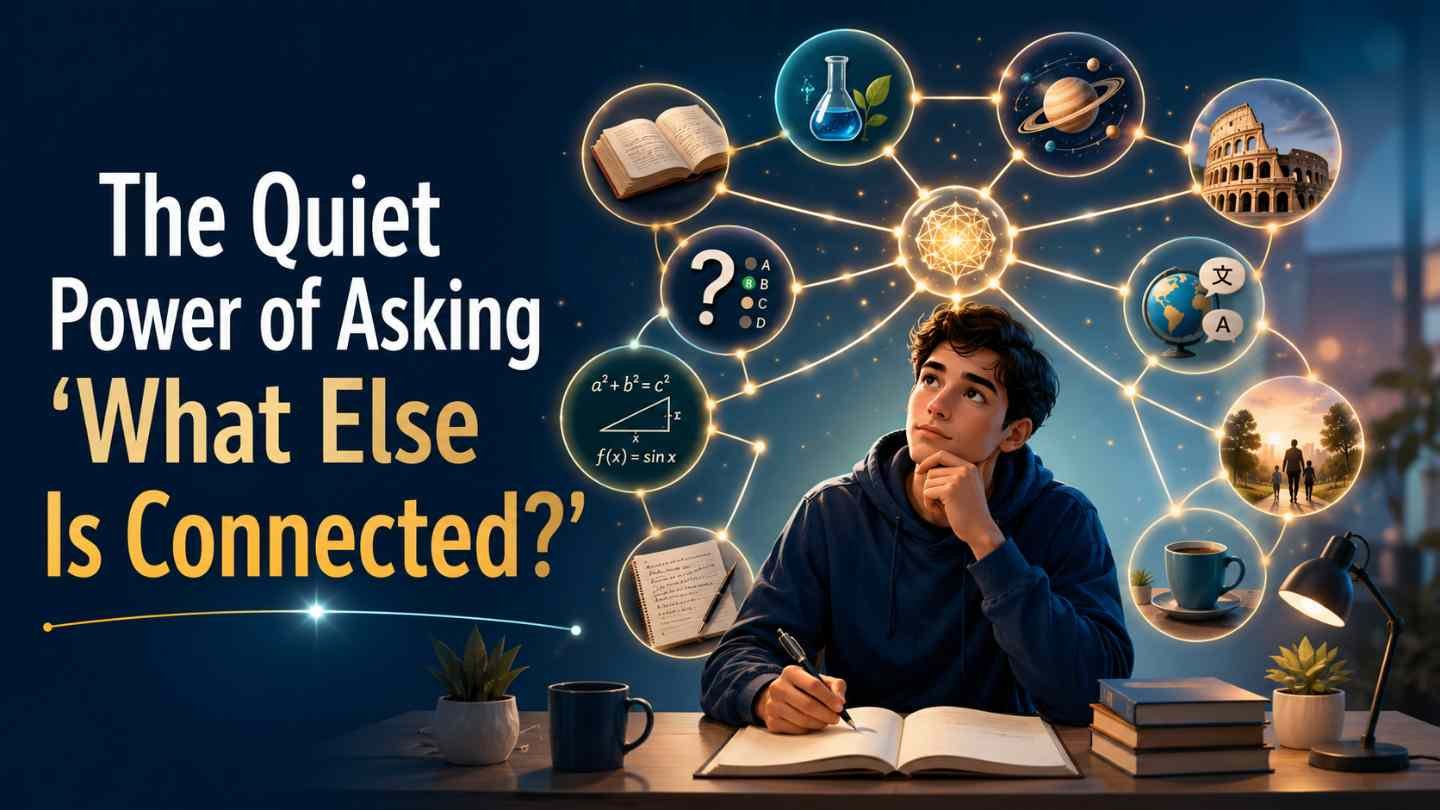
Disconnected information is hard to hold onto.
You may remember a fact for a quiz, a formula for a math test, or a date from history for a few hours. But if that information sits alone in your mind, it fades quickly. It has no roots. It has nowhere to attach.
That is why one of the most useful learning questions is also one of the simplest:
“What else is connected?”
This question turns learning from memorizing loose pieces into building a web of meaning. Instead of treating every fact, lesson, or topic as separate, you begin to notice how ideas support, explain, and strengthen one another.
And once ideas are connected, they become easier to remember, easier to understand, and easier to use.
What Does Asking “What Else Is Connected?” Mean?
Asking “What else is connected?” means looking beyond the single fact in front of you.
It is the habit of pausing and asking:
What does this remind me of?
Where have I seen this idea before?
What caused this?
What does this lead to?
How does this connect to real life?
How does this connect to another subject?
You are not just collecting information. You are linking it.
For example, if you learn that plants need sunlight for photosynthesis, you can stop there and memorize the fact. Or you can ask, “What else is connected?”
That question may lead you to energy, food chains, oxygen, farming, climate, forests, and even your own daily meals.
Suddenly, one science fact becomes part of a bigger picture.
Why Connections Make Learning Easier
Connected Ideas Are Easier to Remember
Memory works better when new information has something familiar to attach to.
A random fact feels slippery. A connected idea has handles.
If you learn a new word in another language, it may be hard to remember by itself. But if you connect it to a picture, a sentence, a personal experience, or a similar word you already know, it becomes easier to recall.
For example, learning the Spanish word casa means “house” is one thing. Connecting it to “my house,” “a family home,” “casita,” and a sentence like “La casa es grande” gives your brain more paths back to the meaning.
The more useful connections you create, the more ways you have to remember.
Connections Create Deeper Understanding
Memorizing tells you what something is.
Connecting helps you understand why it matters.
A learner may memorize that the water cycle includes evaporation, condensation, and precipitation. But asking “What else is connected?” can lead to clouds, rivers, weather, farming, floods, droughts, and drinking water.
That is deeper learning.
You are no longer repeating a list. You are understanding how the parts work together.
Connected Learning Helps You Apply Knowledge
The goal of learning is not only to pass a quiz. It is to use knowledge when it matters.
Connections help you transfer what you learn from one situation to another.
For example, if you understand percentages in math, you can use that knowledge when reading discounts, comparing interest rates, checking tax, understanding statistics, or managing a budget.
The skill becomes useful because it is connected to life outside the lesson.
How to Connect New Information to Old Knowledge
Start With What You Already Know
When you learn something new, do not begin by asking, “How can I memorize this?”
Start with:
“What does this connect to that I already understand?”
If you are studying volcanoes, you may connect them to mountains, earthquakes, heat, pressure, islands, or news reports about eruptions.
If you are reading a story, you may connect a character’s decision to another book, a movie, a real person, or your own experience.
Old knowledge gives new knowledge a place to land.
Look for Causes and Effects
One of the easiest ways to connect ideas is to ask what caused something and what happened next.
In history, a war is not only a date and a name. It has causes, choices, conflicts, consequences, and long-term effects.
In science, a change in temperature may affect matter, weather, animals, or ecosystems.
In everyday life, sleeping late can affect focus, mood, energy, and school or work performance.
Cause and effect turns isolated details into a chain of meaning.
Compare Similar and Different Ideas
Comparison is another powerful connection tool.
Ask:
How is this similar to something I already know?
How is it different?
Why does the difference matter?
In math, fractions, decimals, and percentages are connected because they can describe parts of a whole.
In language learning, synonyms are connected by meaning, but they may differ in tone or usage.
In reading, two characters may face similar problems but respond in different ways.
Comparison sharpens understanding because it forces you to look closely.
Connect Ideas to Real-Life Use
A lesson becomes more memorable when you can see where it appears outside the classroom.
Grammar connects to clearer writing.
Science connects to health, food, weather, and technology.
Math connects to money, time, design, cooking, and measurement.
History connects to laws, culture, conflict, leadership, and current events.
When you ask, “Where would I use this?” the information becomes more practical.
Practical Examples of Connected Learning
Quizzes: Turn Each Question Into a Mini Web
A quiz question is not only a test of memory. It can become a starting point for learning.
Suppose a quiz asks, “Which planet is known as the Red Planet?”
The answer is Mars. But connected learning does not stop there.
Ask:
Why is Mars red?
How is Mars different from Earth?
What missions have explored Mars?
Why are scientists interested in it?
A simple quiz answer becomes a doorway into astronomy, space exploration, geology, and technology.
This is one reason a resource like a bing weekly quiz can be useful for more than quick trivia. When you pause after each answer and ask what else is connected, each question can become a small learning path.
School Subjects: Build Bridges Between Lessons
Subjects often feel separate because they are taught in different classes. But real understanding grows when you build bridges between them.
A lesson on the Industrial Revolution connects to history, economics, science, technology, labor, cities, pollution, and modern factories.
A lesson on nutrition connects to biology, chemistry, health, agriculture, advertising, and personal habits.
A lesson on measurement connects to math, science experiments, cooking, construction, and sports.
The more bridges you build, the less scattered your learning feels.
Reading: Connect the Text to Bigger Ideas
When reading, it is easy to focus only on finishing the page.
But connected reading asks better questions.
What does this paragraph connect to?
What idea keeps coming back?
How does this character’s choice connect to the theme?
How does this article connect to something happening in the world?
For example, if you read a story about courage, connect it to fear, risk, sacrifice, friendship, leadership, and real moments when people choose to do what is right.
Reading becomes richer when you look for relationships between ideas.
Online Learning: Avoid the “Video After Video” Trap
Online learning can feel productive even when it is passive.
You watch one tutorial, then another, then another. But without connections, much of it disappears.
After each video or lesson, ask:
What did I already know?
What was new?
What does this connect to?
Where can I use it today?
If you watch a video about editing photos, connect it to lighting, composition, storytelling, social media, branding, or website design.
That quick connection check helps you turn watching into learning.
Math: Connect Procedures to Meaning
Math becomes frustrating when formulas feel like magic tricks.
Connected learning asks what the procedure means.
For example, instead of only memorizing how to find the area of a rectangle, connect it to rows, columns, tiles, floors, walls, screens, and garden plots.
Area is not just length times width. It is a way to measure how much space a flat surface covers.
When students connect the formula to a real image, the method becomes easier to understand.
Science: Connect Facts to Systems
Science is full of connected systems.
The human body connects organs, cells, oxygen, blood, food, energy, and movement.
Ecosystems connect animals, plants, sunlight, water, soil, predators, and climate.
Electricity connects energy, circuits, switches, batteries, wires, and devices.
If you study one science fact alone, it may feel small. If you place it inside a system, it starts to make sense.
History: Connect Events to People and Consequences
History becomes easier to remember when it is not treated as a list of dates.
Take one event and ask:
Who was affected?
What problem led to it?
What changed afterward?
What ideas were involved?
How does it still matter today?
For example, learning about the printing press connects to books, education, religion, science, language, politics, and the spread of ideas.
One invention changed how people shared knowledge. That connection makes it more memorable than a date alone.
Language Learning: Connect Words to Situations
New vocabulary sticks better when it is connected to real use.
Instead of memorizing a word by itself, connect it to:
A sentence
A picture
A situation
A feeling
A related word
An opposite word
A personal example
For example, learning the word “hungry” becomes stronger when you connect it to “food,” “lunch,” “tired,” “restaurant,” “I am hungry,” and a real moment before eating.
Language lives in context. Connected learning gives words that context.
Everyday Life: Notice Learning Around You
Connected learning is not only for school.
If you compare prices at a store, you are using math.
If you read a news headline, you are using history and media literacy.
If you follow a recipe, you are using measurement and sequencing.
If you fix a small problem at home, you are using observation and cause-and-effect thinking.
Asking “What else is connected?” helps you notice that learning is already part of daily life.
Self-Study: Make Your Notes More Useful
Self-study can become messy when notes are only copied information.
A better method is to add connection lines.
After writing a fact, add:
This connects to…
This reminds me of…
This matters because…
An example is…
I can use this when…
For example:
Fact: Exercise improves circulation.
Connection: This connects to heart health, energy, oxygen, stress, sleep, and daily movement.
That small addition makes the note more useful for review.
A Simple Five-Minute “Connection Check” Exercise
Use this exercise after reading, watching a lesson, answering a quiz, or studying a topic.
Minute 1: Choose One Idea
Pick one fact, question, formula, word, event, or concept you just learned.
Write it clearly in one sentence.
Example: “Photosynthesis helps plants make food using sunlight.”
Minute 2: List Three Connected Ideas
Ask, “What else is connected?”
Write three related ideas.
Example:
Sunlight
Oxygen
Food chains
Minute 3: Add One Real-Life Example
Connect the idea to something practical or familiar.
Example: “Plants growing in a garden need sunlight because they use it to make food.”
Minute 4: Ask One Deeper Question
Write one question that opens the idea further.
Example: “What happens to plants when they do not get enough sunlight?”
Minute 5: Explain the Connection in Your Own Words
Write two or three sentences explaining how the ideas fit together.
Example: “Photosynthesis connects sunlight, plants, oxygen, and food. Plants use sunlight to make food, and this process also supports animals and people because plants are part of the food chain.”
In five minutes, you have moved from memorizing a fact to understanding a small system.
Common Mistakes to Avoid When Connecting Ideas
Connecting Everything Too Randomly
Not every connection is useful.
If the connection does not help you understand, remember, explain, or apply the idea, it may only create confusion.
Useful connections are clear and meaningful. Random connections are noisy.
Ask yourself, “Does this connection make the idea easier to understand?”
Trying to Make Too Many Connections at Once
Connected learning does not mean building a giant map every time you study.
Start small.
Three strong connections are better than fifteen weak ones.
For most lessons, one old idea, one example, and one question are enough to deepen understanding.
Forgetting the Main Idea
Connections should support the main idea, not bury it.
If you are studying fractions, connections to pizza, money, measurement, and percentages can help. But you still need to understand what a fraction means.
Keep returning to the center: “What is the main idea I am trying to learn?”
Only Connecting Easy Ideas
It is tempting to connect only what feels obvious.
But deeper learning often comes from connecting ideas that seem separate at first.
For example, history and technology connect through inventions. Math and art connect through patterns and design. Science and everyday life connect through health, weather, and energy use.
Do not force connections, but stay curious.
Copying Connections Without Thinking
A teacher, book, or video can show you connections, but the strongest learning happens when you make some of them yourself.
Personal connections are powerful because they come from your own memory and experience.
When you build the link, you are more likely to remember it.
Why This Question Works So Quietly
“What else is connected?” does not feel dramatic.
It is not a complicated study system. It does not require special tools. It does not ask you to study for hours.
But it changes how you pay attention.
Instead of seeing learning as a pile of separate facts, you begin to see it as a network. One idea points to another. One subject supports another. One question opens a new path.
That is the quiet power of the question.
It helps you move from “I know this fact” to “I understand how this fits.”
And that is where real learning begins.
FAQ
What does “What else is connected?” mean in learning?
It means looking for relationships between ideas instead of studying each fact by itself. You connect new information to what you already know, real-life examples, causes, effects, patterns, and related topics.
Why are connected ideas easier to remember?
Connected ideas are easier to remember because they give your brain more ways to find the information again. A fact linked to examples, meaning, and prior knowledge is usually easier to recall than a fact memorized alone.
Can this method help with quizzes?
Yes. After answering a quiz question, ask what topic, fact, example, or explanation connects to it. This turns a single answer into a stronger learning moment.
How can I use this method in self-study?
After studying one idea, write three connected ideas, one real-life example, and one question. This quick habit can make your notes more meaningful and easier to review.
Is connected learning useful for all subjects?
Yes. It can help in math, science, history, reading, language learning, online courses, and everyday problem-solving. The type of connection may change, but the habit works across many learning situations.
Author

Althea is a contributing writer at bingquiz.weeklyquiz.net, specializing in trivia design and fact-checking across news, history, and pop culture. With a background in research and digital publishing, she focuses on crafting quizzes that are accurate, engaging, and easy to play. Her work is guided by a commitment to clarity, reliability, and providing readers with trustworthy knowledge in a fun format.
