
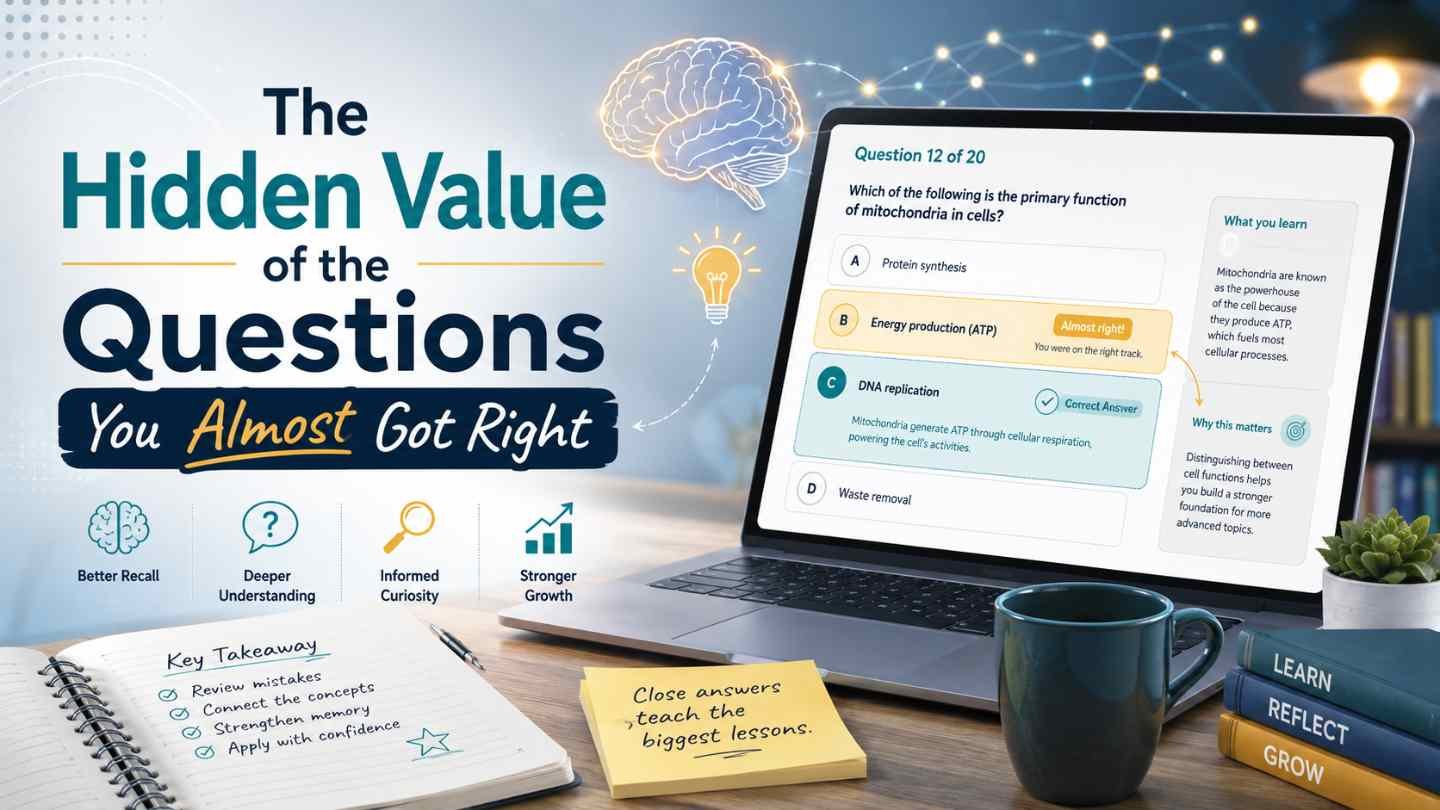
A completely wrong answer is usually easy to recognize. You may not know the subject, you may have forgotten the fact, or the question may cover something you have never studied. The questions you almost got right are more revealing because they show that useful knowledge is already present—it simply needs a small correction.
Perhaps you remembered the right historical event but chose the wrong year. Maybe you knew which region a capital belonged to but selected a neighboring country. These near-misses are not ordinary mistakes. They are precise learning signals that point to the exact part of your knowledge that needs strengthening.
Instead of reviewing an entire topic again, you can focus on the one date, name, definition, location, or connection that caused the confusion. That makes quiz review faster, more practical, and often more memorable.
Why Almost-Correct Answers Matter
Almost-correct answers sit between knowing and not knowing. They often reveal partial knowledge: you recognize the subject, recall some of the relevant information, and may even eliminate several wrong choices. However, one uncertain detail keeps you from reaching the correct answer.
This is useful because the gap is usually small enough to identify. You do not need to relearn everything about the Roman Empire because you confused Julius Caesar with Augustus. You need to clarify their roles, their relationship, and which man became Rome’s first emperor.
Completely wrong answers may expose broad knowledge gaps. Questions you almost got right often expose something narrower—a weak connection, two similar facts stored together, or a memory that lacks enough context to remain dependable.
What a Near-Miss Can Reveal
You Remembered the Topic but Confused the Detail
Many almost-correct answers happen because the general subject feels familiar while the exact detail remains uncertain. You may know that the American Declaration of Independence was adopted in the 1770s but hesitate between 1776 and 1777. The broad knowledge is present; the precise date needs reinforcement.
The same issue appears with names and historical figures. A learner might remember that Alexander Fleming was connected with penicillin but choose Louis Pasteur because both names are strongly associated with scientific discovery. Reviewing the difference between their contributions is more useful than simply memorizing that one choice was wrong.
Two Similar Facts Are Competing in Memory
Quiz questions often place closely related answers together. That can reveal facts that have become tangled in memory. Someone may confuse Canberra with Sydney when naming Australia’s capital because Sydney is the country’s most internationally recognized city.
Scientific terms create similar problems. Evaporation and condensation both involve water changing form, but they describe opposite processes. Choosing condensation for a question about liquid water becoming vapor shows that the learner recognizes the correct topic while confusing the direction of the change.
These almost-correct answers help separate ideas that have been stored too closely together. Once the distinction becomes clear, both facts may become easier to recall.
You Know the Definition but Not Its Exact Boundary
Definitions can feel familiar even when they are not fully understood. For example, a person may describe a herbivore as an animal that “mostly eats plants.” That sounds close, but the basic definition is an animal that feeds on plants.
A geography question may ask for the meaning of an archipelago. A learner might choose “a group of connected islands” instead of the more accurate “a group or chain of islands.” The answer shows partial understanding, but it also identifies the wording or concept that needs refinement.
This is why educational quizzes can be useful beyond scoring. They test whether knowledge is precise enough to use, not merely familiar enough to recognize.
You Recalled the Right Area but the Wrong Location
Locations are especially easy to mix up because nearby places often share cultural, historical, or geographic connections. A learner may know that Bratislava is a European capital but confuse Slovakia with Slovenia. Another may place Mount Kilimanjaro in Kenya rather than Tanzania because the mountain is close to the Kenyan border and often viewed from Kenya.
These are valuable knowledge gaps because they can be repaired with one strong geographical connection. Linking Bratislava with Slovakia and Ljubljana with Slovenia creates a clearer mental pair. Locating Kilimanjaro on a map adds context that a country name alone may not provide.
Almost Correct Is Not the Same as Almost Knowing
Being close is encouraging, but it should not become an excuse to skip the explanation. A near-miss may indicate genuine partial knowledge, or it may result from a lucky guess. The only way to tell is to examine how you reached the answer.
Suppose you correctly eliminate two choices and hesitate between the remaining two. That shows more understanding than selecting an answer randomly. Yet you still need to verify the correct response and learn why it is right.
Understanding the context matters as much as recognizing the final answer. Knowing that Ottawa is Canada’s capital is useful. Knowing that Toronto is the largest city while Ottawa is the national capital makes the distinction easier to retain.
How to Identify Why You Almost Got It Right
After a quiz, do not treat every incorrect response in the same way. Look at each near-miss and ask what caused it. The mistake will usually fall into one of several simple categories.
You may have confused two similar facts, remembered only part of the answer, overlooked an important word, guessed between close options, or recalled something related but not directly relevant. Naming the cause turns a vague mistake into a specific correction.
For example, imagine a question asks, “Which scientist proposed the three laws of motion?” You choose Galileo instead of Isaac Newton. Rather than merely noting the correct name, identify the source of confusion: both scientists studied motion, but Newton formulated the three laws commonly taught under that name.
That small explanation gives the answer a useful structure. It becomes more than an isolated fact.
Separate Knowledge Gaps From Careless Reading
Not every almost-correct answer reflects weak memory. Sometimes the knowledge was accurate, but the question was read too quickly.
Words such as not, except, first, largest, former, and closest can completely change what a question is asking. A learner might know that the Nile is one of the world’s longest rivers but miss a question asking for the largest river by discharge, which points to the Amazon.
When reviewing the mistake, ask whether you misunderstood the subject or overlooked the wording. If the answer came from careless reading, the solution is not more memorization. It is slowing down long enough to identify the question’s key condition.
This distinction makes recall practice more efficient. You strengthen knowledge when knowledge is weak and improve attention when attention caused the error.
Recognize Uncertain Guessing
Sometimes an answer feels almost correct only because the final choice was close to the correct one. That does not necessarily mean the underlying knowledge was strong. If you guessed between four capitals without knowing which country any of them belonged to, the near-miss provides less evidence of learning.
A useful test is to explain why you selected the answer. Could you eliminate any options for a clear reason? Did you remember a related fact? Were you choosing between two genuinely plausible responses?
Uncertain guessing is not useless. It can spark curiosity and make the answer more memorable once revealed. Still, it should be labeled honestly so that confidence does not grow faster than understanding.
A Simple Method for Reviewing Near-Misses
You do not need to repeat an entire lesson every time you miss a small detail. Use a short three-step method instead.
1. Name the Confusion
State exactly what became mixed up. For example: “I confused Slovenia’s capital with Slovakia’s capital,” or “I remembered the correct century but chose the wrong year.”
This step prevents the review from becoming vague. “I got it wrong” tells you very little. “I mixed up two similar country names” identifies the problem.
2. Write the Correct Distinction
Create one brief comparison that separates the facts:
- Bratislava — Slovakia
- Ljubljana — Slovenia
- Evaporation — liquid to gas
- Condensation — gas to liquid
- Augustus — first Roman emperor
- Julius Caesar — Roman general and dictator
A direct contrast is often easier to remember than a long explanation because it shows both the correct fact and the source of confusion.
3. Recall It Again Later
Cover the answer and test yourself after a few minutes, later in the day, or during another quiz. This extra retrieval step helps move the corrected information from temporary recognition toward reliable memory.
The entire review may take less than a minute. What matters is that you identify, correct, and retrieve the weak detail instead of merely reading the answer and moving on.
Practical Ways to Strengthen the Missing Detail
Add One Piece of Context
Facts become easier to remember when they connect to something meaningful. Instead of memorizing only “Canberra is the capital of Australia,” connect it with the reason Sydney and Melbourne were not selected. Canberra was developed as a compromise location between the two major cities.
For a historical date, attach the event to a short timeline. If you confuse 1492 with another late-15th-century date, connect 1492 with Columbus’s first voyage across the Atlantic. Context gives the number somewhere to belong.
Compare Similar Names Directly
When names are the problem, place them side by side. Compare Charles Darwin with Charles Dickens, or Marie Curie with Pierre Curie. Note the field, achievement, nationality, or relationship that separates them.
This approach works well in general knowledge because many quiz errors involve familiar names attached to the wrong achievement. The goal is not just to remember each name separately but to stop them from competing for the same mental space.
Use a Tiny Mental Image
A simple image can help with locations and scientific processes. Picture water rising as vapor for evaporation and droplets forming on a cold glass for condensation. Imagine the maple leaf beside Ottawa to connect the city with Canada.
The image does not need to be clever or elaborate. It only needs to make the correct answer easier to retrieve than the competing one.
Turn the Correction Into a New Question
After reviewing an almost-correct answer, rewrite it from another angle. If the original question asked for the capital of Slovakia, ask yourself which country has Ljubljana as its capital. If the question asked who developed the theory of evolution by natural selection, ask what Charles Darwin is best known for.
This builds flexible recall. You are no longer depending on one exact wording or one familiar set of answer choices.
Why Near-Misses Can Improve Memory
Memory improvement often happens when the brain notices a mismatch between what it expected and what turned out to be correct. A near-miss creates that moment clearly. You thought the answer was 1918, but it was 1919. You chose mitosis, but the question described meiosis.
Because the wrong and correct answers are closely related, the contrast may attract more attention than a fact that was completely unfamiliar. The correction answers a specific uncertainty that was already active in your mind.
That does not guarantee permanent learning. You still need to review the fact and retrieve it again. However, a carefully examined near-miss gives you an excellent starting point for stronger recall.
Use Daily Quizzes as a Learning Check
Daily quizzes provide a practical way to notice small changes in knowledge. Over time, you begin to see patterns in the questions you almost got right. Perhaps dates are easy to confuse, scientific vocabulary needs more context, or capitals in a particular region remain uncertain.
Treat those patterns as guidance rather than criticism. They show where a few minutes of focused review may have the greatest benefit. A regular bing knowledge quiz can also expose you to varied subjects, helping you connect history, geography, science, culture, and everyday facts.
The score still has value, but it is only one part of the experience. The more useful question is often: “What did this quiz show me about the way I remember information?”
Keep Curiosity in the Review Process
Near-misses can lead beyond the original question. Confusing two capitals may encourage you to look at a map. Mixing up two inventors may lead you to compare their discoveries. Forgetting a definition may reveal an entire concept that deserves another look.
This is where quiz learning becomes more than collecting correct answers. A small correction can open a larger subject without requiring a long study session. Curiosity turns the missed detail into a doorway rather than a dead end.
The process should remain manageable. You do not need to research every answer deeply. Choose the near-misses that interest you or appear repeatedly, then add enough context to make the correct fact clear.
Final Thoughts
The questions you almost got right can be some of the most useful questions in a quiz. They reveal knowledge that is already forming while pointing directly to the weak date, mixed-up name, uncertain definition, confused location, or missing connection that needs attention.
Being close is a positive sign, but it is not the end of the learning process. Verify the complete answer, understand why it is correct, and compare it with the fact that caused the confusion. A short, focused review can often repair the gap without repeating an entire lesson.
When near-misses are treated as precise learning signals instead of ordinary mistakes, quizzes become more informative. They help you think carefully, strengthen recall, build general knowledge, and discover exactly what to learn next.
Author

Althea is a contributing writer at bingquiz.weeklyquiz.net, specializing in trivia design and fact-checking across news, history, and pop culture. With a background in research and digital publishing, she focuses on crafting quizzes that are accurate, engaging, and easy to play. Her work is guided by a commitment to clarity, reliability, and providing readers with trustworthy knowledge in a fun format.
