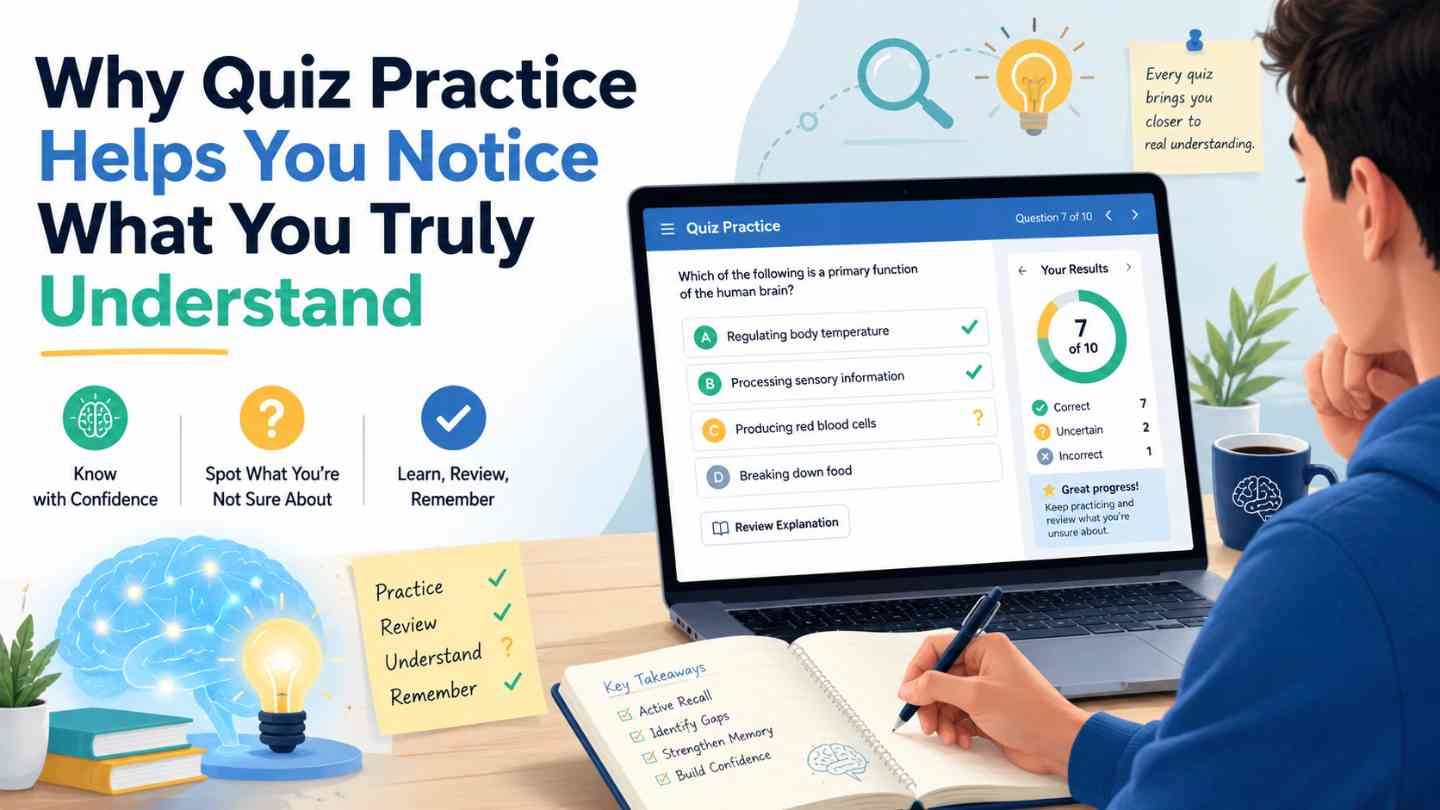
Quiz practice does something simple but powerful: it makes your knowledge visible. When you read an article, watch a video, or hear a fact, it can feel like you understand it. But the real test comes when you have to answer a question without looking at the explanation first.
That is where quiz practice becomes useful. It shows the difference between what you truly understand, what you only partly remember, and what you are mostly guessing. This makes quizzes more than a score-checking activity. They become a small mirror for your learning.
A fresh way to think about quiz practice is this: every question is a “truth check” for your brain. It does not only ask, “Do you know this?” It also asks, “Can you use this knowledge when you need it?”
Quiz Practice Reveals the Gap Between Knowing and Feeling Familiar
One reason quiz practice works so well is that it exposes the gap between knowing something and simply recognizing it. A fact may look familiar because you have seen it before, but that does not always mean you can remember it clearly. For example, you may recognize the name of a famous scientist, but struggle to explain what that person discovered.
That small struggle is useful. It tells you where your memory is strong and where it needs support. Instead of assuming you know a topic because it sounds familiar, quiz practice helps you check whether the information is really stored in your mind.
This is especially helpful for general knowledge, news, history, science, and educational quizzes. Many topics feel easy when the answer is shown, but become harder when you must recall the answer yourself.
Knowing, Guessing, and Recognizing: What Is the Difference?
Quiz practice helps you separate three common learning states: knowing, guessing, and recognizing. These may feel similar during a quiz, but they are not the same.
1. Knowing
You know something when you can answer confidently and explain why the answer is correct. For example, if a quiz asks which planet is known as the Red Planet, and you answer Mars while also knowing it looks reddish because of iron oxide on its surface, that is stronger understanding.
2. Guessing
Guessing happens when you choose an answer without much confidence. You may get it right, but the correct result does not always mean you truly understand the topic. A lucky guess should still be reviewed because it points to knowledge that is not yet stable.
3. Recognizing
Recognizing happens when an answer feels familiar after you see it. This can be helpful, but it is weaker than recall. You might think, “Oh yes, I knew that,” but if you could not bring the answer to mind before seeing the choices, it means the idea needs more review.
This is why quiz learning is so useful. It does not just tell you whether an answer is right or wrong. It helps you understand the quality of your knowledge.
Why Correct Answers Still Need Review
Many people only review wrong answers, but correct answers can also teach you something. A correct answer can come from real understanding, partial memory, or a lucky guess. If you do not check why you got it right, you may overestimate how well you know the topic.
After each quiz, ask yourself: “Did I know this clearly, or did I just pick the best-looking option?” This simple question turns quiz practice into a stronger learning habit. It also helps with memory improvement because your brain gets another chance to connect the answer with the reason behind it.
This matters a lot in daily quizzes. When you answer a few questions every day, the goal is not only to collect scores. The better goal is to notice which facts are becoming easier to recall over time.
How Quiz Practice Finds Your Strong Knowledge
Your strong knowledge usually shows up in questions you answer quickly, confidently, and correctly. These are topics you can recall without much pressure. They may be facts you have reviewed often, subjects you enjoy, or ideas connected to things you already understand.
For example, if you often read sports news, you may answer sports questions faster than science questions. If you enjoy history documentaries, historical trivia may feel easier. Quiz practice helps you see these patterns.
Knowing your strengths is useful because it builds confidence. It reminds you that learning is not only about fixing mistakes. It is also about recognizing the areas where your memory and understanding are already working well.
How Quiz Practice Shows Your Weak Spots
Weak spots often appear in three ways. First, you answer incorrectly. Second, you guess and get lucky. Third, you recognize the answer only after seeing the explanation. All three are signs that the topic needs more attention.
This is not a bad thing. In fact, weak spots are some of the most valuable results in quiz learning. They tell you exactly where to review instead of wasting time studying everything equally.
For example, if you keep missing questions about world geography, that gives you a clear next step. You might review maps, capital cities, regions, or major landmarks. A quiz result becomes a guide, not a judgment.
Using Answer Review to Build Real Understanding
Answer review is where quiz practice becomes deeper. Without review, a quiz can become just a quick game. With review, it becomes a learning tool.
When you review an answer, do not only look at the correct choice. Read the explanation, compare it with your original thinking, and notice what confused you. Maybe two choices looked similar. Maybe you remembered an old fact incorrectly. Maybe you understood the topic, but missed one important detail.
This habit helps you truly understand the answer instead of only memorizing it. It also strengthens recall practice because your brain has to revisit the idea and correct the mistake.
Practical Tips for Getting More From Quiz Practice
Mark Each Answer by Confidence
After answering, mentally label your response as “sure,” “unsure,” or “guess.” This helps you avoid treating all correct answers the same way. A correct guess needs more review than a confident correct answer.
Review Wrong Answers First
Wrong answers show the clearest learning gaps. Read the explanation and ask why the correct answer makes sense. This helps turn a mistake into a useful memory cue.
Do Not Ignore Lucky Guesses
A lucky guess can feel like a win, but it is also a warning. You got the point, but the knowledge may not be reliable yet. Add that topic to your review list.
Look for Repeated Patterns
If you keep missing the same type of question, that is a sign. Maybe you struggle with dates, vocabulary, science terms, or current events. Patterns tell you where your next learning effort should go.
Use Daily Quizzes for Small Practice
Daily quizzes work well because they keep learning light and consistent. A few questions each day can improve focus, memory, and curiosity without feeling like a heavy study session. You can try resources like daily bing quizzes to make quiz practice part of a simple routine.
Read the Explanation Before Moving On
The explanation is often more valuable than the score. It gives context, corrects confusion, and helps the fact stay in your memory longer. This is where quick trivia turns into real understanding.
Why Quiz Practice Supports Memory Improvement
Quiz practice helps memory because it makes your brain retrieve information. Reading is often passive, but answering a question requires effort. That effort is what makes recall practice useful.
When you try to remember an answer, your brain strengthens the path to that information. Even if you get the answer wrong, the correction can help you remember it better next time. This is why a short quiz with review can sometimes teach more than simply rereading a long page.
Memory improvement also grows through repetition. If you meet the same idea in different quiz questions over time, it becomes easier to recall. The fact moves from “I think I saw this before” to “I actually know this.”
Quiz Practice Builds Curiosity and Focus
A good quiz question creates a small moment of curiosity. You want to know whether your answer is right. You want to see what you missed. You want to understand why one choice works and the others do not.
That curiosity helps focus. Instead of reading a topic with your mind half elsewhere, a quiz gives you a reason to pay attention. It turns learning into a small challenge.
This is why educational quizzes can be helpful for students, casual readers, and anyone who wants to build general knowledge. They make learning active, not just something you passively scroll through.
The Balanced Truth About Quiz Practice
Quiz practice is helpful, but it is not magic by itself. A quiz can show you what you know, but the real learning happens when you review the explanation and understand why the answer is correct. Without that step, quizzes can become a guessing game.
The best approach is simple: answer, check, review, and repeat. Use the score as feedback, not as the final goal. A high score feels good, but a reviewed mistake may teach you more.
When used this way, quiz practice becomes a practical tool for daily learning. It helps you build memory, sharpen focus, and notice what you truly understand.
FAQs About Quiz Practice
1. What is quiz practice?
Quiz practice means using questions to test what you know and strengthen what you are learning. It can include trivia quizzes, educational quizzes, daily quizzes, subject-based quizzes, or review questions after reading.
2. How does quiz practice help you truly understand a topic?
Quiz practice forces you to recall information instead of only recognizing it. When you answer a question, you quickly see whether you can remember the idea clearly, whether you are guessing, or whether you need more review.
3. Is getting a high quiz score the main goal?
A high score is nice, but it should not be the only goal. The real value of quiz learning comes from reviewing answers, understanding mistakes, and noticing which topics need more attention.
4. Why should I review correct answers too?
Correct answers are not always proof of strong understanding. Sometimes you guess correctly or recognize the answer without fully knowing why it is right. Reviewing correct answers helps make your knowledge more reliable.
5. How often should I do quiz practice?
Short daily quizzes can work well because they keep your memory active without taking too much time. Even five to ten questions a day can help if you review the answers carefully.
6. Can quiz practice improve general knowledge?
Yes. Quiz practice can help you build general knowledge by exposing you to facts from news, history, science, geography, entertainment, sports, and other topics. The key is to read the explanations, not just check the score.
7. What should I do after getting an answer wrong?
Read the explanation and ask yourself why your answer was wrong. Then connect the correct answer to a simple reason, example, or memory clue. This makes it easier to remember the information next time.
Conclusion
Quiz practice helps you notice what you truly understand because it turns hidden knowledge into clear feedback. It shows what you know confidently, what you are only guessing, and what feels familiar but still needs review. That difference matters because real learning is not just about seeing facts. It is about being able to recall them, explain them, and use them later.
The best quiz habit is not complicated. Take the quiz, check your confidence, review the explanations, and pay attention to repeated weak spots. Over time, this simple routine can improve memory, build curiosity, and make daily learning feel easier and more useful.